
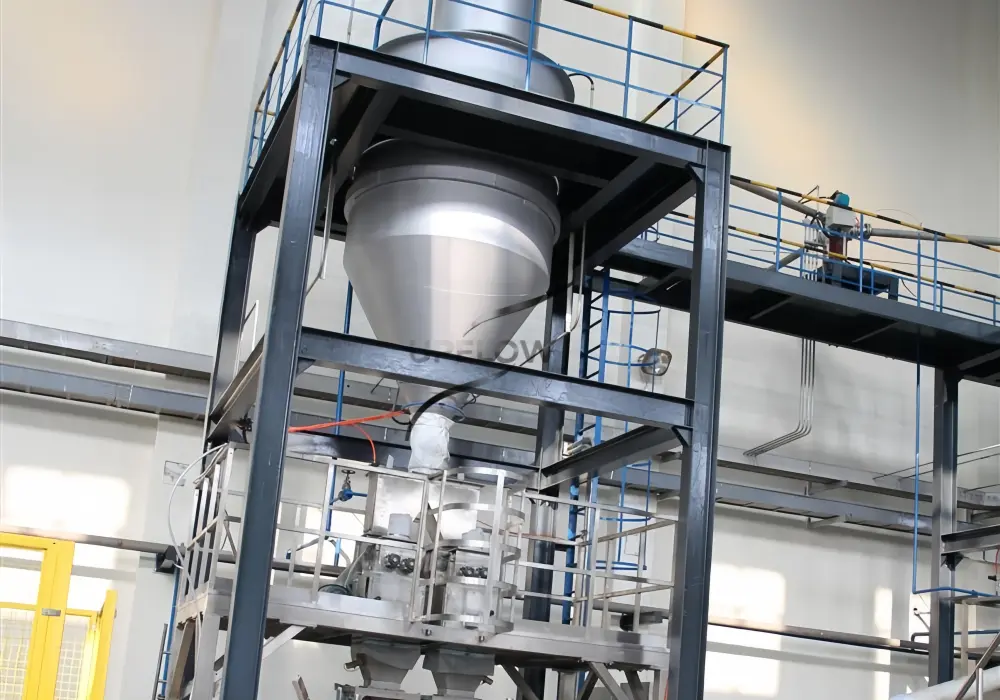
In modern bulk material handling industries where precision, cleanliness, and continuous automation are increasingly required, the magnesium oxide pneumatic conveying system has emerged as a highly efficient engineering solution for transporting fine and reactive powders across complex production environments, enabling stable enclosed transfer while minimizing dust emission, contamination risks, and operational downtime in large-scale manufacturing plants.
Overview of Magnesium Oxide Material in Industrial Applications
Magnesium oxide, commonly known as magnesia, with the chemical formula MgO, is a white hygroscopic solid mineral widely used in industrial sectors such as refractories, construction materials, environmental treatment, chemical processing, and pharmaceutical manufacturing, and it is typically produced through the calcination of magnesite or magnesium hydroxide, resulting in a material that exhibits high thermal stability, strong alkalinity, fine particulate structure, and moderate abrasiveness depending on processing conditions.
Due to these physical and chemical properties, magnesium oxide requires a carefully controlled handling environment, and in modern powder engineering systems such as the magnesium oxide pneumatic conveying system, its fine particle behavior, tendency to absorb moisture, and dust-forming characteristics make enclosed transport essential to ensure product stability and workplace safety, especially when integrated with a magnesium oxide positive pressure conveying system designed for high-capacity continuous flow operations.
In addition, certain production environments may also require a magnesium oxide vacuum conveying system to support precision feeding and controlled dosing applications, particularly in pharmaceutical or fine chemical processes where contamination control is critical.
Challenges in Handling Magnesium Oxide Powder
Despite its widespread industrial applications, magnesium oxide powder presents several handling challenges during transportation, including moisture sensitivity, particle cohesion, dust dispersion, and pipeline buildup, all of which can significantly impact production efficiency if not properly managed through engineered conveying solutions.
For this reason, the magnesium oxide pneumatic conveying system is widely adopted to ensure fully enclosed and automated transport, reducing human contact and minimizing environmental exposure, while systems such as the magnesium oxide positive pressure conveying system are often preferred in large-scale production facilities where long-distance and high-volume transport is required.
At the same time, the magnesium oxide pneumatic conveying system must be carefully designed to avoid material degradation and flow instability, especially when operating under variable production loads or when integrated into multi-line industrial processes.
Working Principle of Magnesium Oxide Pneumatic Conveying System
The magnesium oxide pneumatic conveying system operates by utilizing compressed air or vacuum pressure to move magnesium oxide powder through a sealed pipeline network, enabling controlled, continuous, and dust-free transportation between storage silos, processing units, and packaging systems.
In a magnesium oxide positive pressure conveying system, compressed air is introduced at the feeding point to push the material through the pipeline, ensuring stable high-throughput transport suitable for large-scale industrial applications, while in a magnesium oxide vacuum conveying system, negative pressure is used to pull the material toward the receiving end, offering higher precision and reduced leakage risk in sensitive production environments.
Both configurations are often integrated into a unified magnesium oxide pneumatic conveying system, allowing flexible operation depending on process requirements and production scale.
System Configurations: Positive Pressure, Vacuum, and Enclosed Conveying
Depending on industrial layout and process requirements, the magnesium oxide pneumatic conveying system can be designed in multiple configurations, including dense phase and dilute phase transport modes, with each configuration offering specific advantages in terms of efficiency, energy consumption, and material integrity.
The magnesium oxide positive pressure conveying system is typically used for long-distance and high-capacity transport scenarios, where stable airflow and continuous feeding are essential, while the magnesium oxide vacuum conveying system is commonly applied in precision dosing environments where contamination control and flexible routing are required.
Meanwhile, the magnesium oxide enclosed conveying system ensures that the entire transport process is isolated from external environmental conditions, significantly reducing dust leakage and improving overall plant safety, especially in facilities handling fine chemical powders.
Together, these systems form a comprehensive magnesium oxide pneumatic conveying system capable of supporting diverse industrial applications with high operational reliability.
Design Considerations for Magnesium Oxide Conveying Systems
When designing a magnesium oxide pneumatic conveying system, engineers must carefully evaluate particle size distribution, moisture sensitivity, pipeline friction, air velocity, and system pressure balance, as magnesium oxide behavior can vary significantly depending on calcination temperature and purity level.
The magnesium oxide positive pressure conveying system must maintain optimized pressure levels to avoid excessive particle attrition while ensuring smooth and uninterrupted flow, whereas the magnesium oxide vacuum conveying system must be calibrated to achieve stable suction force without causing pipeline blockage or material compaction.
In addition, the magnesium oxide enclosed conveying system must incorporate high-quality sealing components and corrosion-resistant pipeline materials to ensure long-term operational stability and minimize maintenance requirements in demanding industrial environments.
Industrial Advantages of Magnesium Oxide Pneumatic Conveying System
The implementation of a magnesium oxide pneumatic conveying system provides significant operational advantages, including improved automation, reduced labor dependency, enhanced environmental protection, and superior process consistency, all of which contribute to higher production efficiency and reduced operational costs in modern manufacturing facilities.
The magnesium oxide positive pressure conveying system enables efficient large-scale transport across long distances, while the magnesium oxide vacuum conveying system offers precise and contamination-free feeding capabilities, making it ideal for high-value or sensitive applications.
Meanwhile, the magnesium oxide enclosed conveying system ensures full containment of fine powder materials, significantly reducing dust-related hazards and improving workplace safety standards, particularly in industries where strict environmental regulations are enforced.
Conclusion
As industrial automation continues to evolve, the magnesium oxide pneumatic conveying system plays an increasingly important role in enabling safe, efficient, and fully enclosed powder transport solutions for magnesium oxide materials across diverse industries, from heavy manufacturing to fine chemical processing.
By integrating advanced configurations such as the magnesium oxide positive pressure conveying system, the magnesium oxide vacuum conveying system, and the magnesium oxide enclosed conveying system, modern production facilities can achieve a highly optimized material handling infrastructure that ensures consistent performance, improved safety, and long-term operational sustainability within complex industrial environments.