
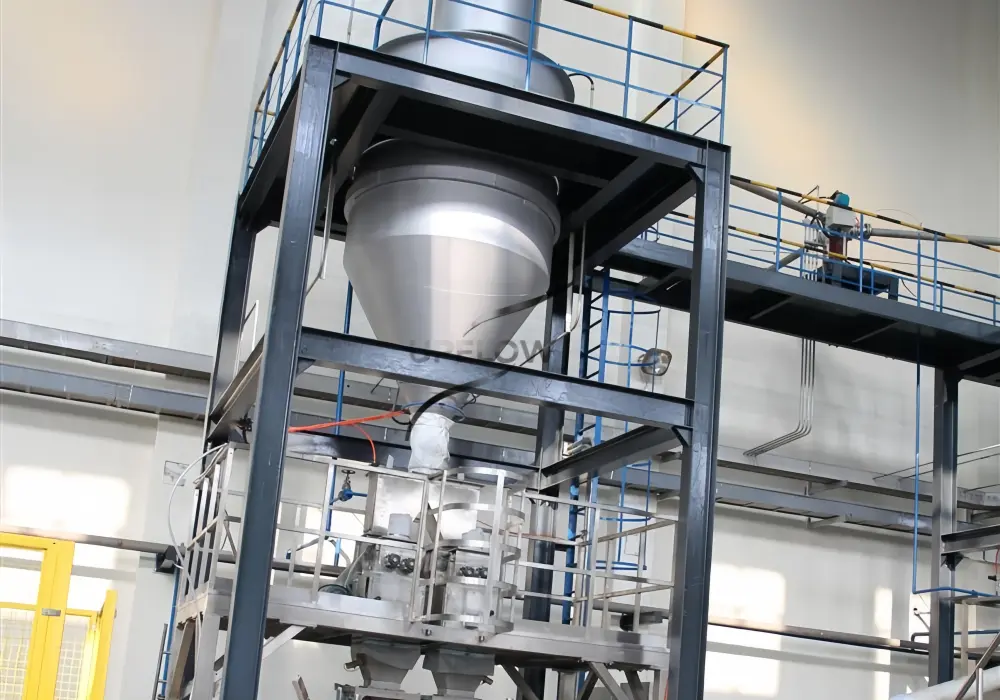
Magnesium Oxide Pneumatic Conveying System for Industrial Powder Handling
A magnesium oxide pneumatic conveying system transfers MgO powder through an enclosed pipeline between feeding, storage and processing equipment. Selecting the configuration starts with the actual magnesia grade, required throughput, conveying route and receiving process. The material name alone is not enough to determine pipe size, air requirements or an achievable transfer rate.
For a new line or an existing plant upgrade, review the powder specification together with the feeding, filtration, receiver discharge and control sequence. This establishes a practical basis for comparing a magnesium oxide positive pressure conveying system with a magnesium oxide vacuum conveying system.
Why the magnesium oxide grade matters
Magnesium oxide, also called magnesia, is supplied in grades with different physical and chemical properties. Martin Marietta Magnesia Specialties’ product information distinguishes light-burned, hard-burned, dead-burned and specialty MgO, including differences in reactivity. This is a reason to obtain the supplied grade’s current technical data rather than apply one handling assumption to all magnesium oxide powders.
Ask for the particle-size distribution, loose and tapped bulk density where available, moisture information, material temperature and applicable SDS. Keep the measurement basis with each value. A particle density is not a substitute for the bulk density used to assess hopper volume and feeding duty.
Describe observed handling problems, such as dust release during unloading, hopper bridging, sticking after storage or inconsistent receiver discharge. Confirm whether moisture exposure or a change in particle condition is relevant to the customer’s specification; do not assume identical sensitivity for every grade.
Define the complete MgO powder transfer duty
| Design input | What to provide | What it helps establish |
|---|---|---|
| Material specification | Supplier, grade, particle size, bulk density and SDS | Powder-specific feeding and transfer requirements |
| Production demand | Normal and peak rate, batch weight and refill time | Required transfer duty and operating sequence |
| Source and route | Bag, FIBC, silo or hopper; route, lift and bends | Unloading, feeding and pipeline scope |
| Receiving equipment | Inlet drawing, headroom, venting and discharge arrangement | Receiver and downstream process interfaces |
| Quality and acceptance | Relevant contamination, moisture, residue and output limits | What must be inspected or tested |
State whether the requirement is continuous material supply, intermittent hopper refill or charging between mixer batches. If several destinations share a line, explain whether they can be served sequentially. The same hourly demand can require different equipment when the available transfer time changes.
Positive pressure or vacuum conveying for magnesium oxide?
In a positive pressure conveying system, the air source and feeding arrangement introduce material into a pressurized conveying line. Assess the inlet feeding device, leakage paths, receiver venting and connected equipment’s pressure conditions together.
A vacuum conveying system draws material towards a receiver at pressure below the surrounding atmosphere. The pickup arrangement, filter condition, receiver volume and discharge cycle need to match the actual MgO powder and production schedule.
Neither method automatically provides precise dosing, zero dust leakage or a guaranteed capacity. Dense-phase or dilute-phase operation also needs application-specific assessment. Compare proposals using the same grade, route, operating duty and product acceptance criteria.
Check feeding, filtration and receiver discharge
Stable airflow cannot compensate for a hopper that does not feed consistently or a receiver that cannot discharge. Review the hopper outlet, feeding device and any flow-assistance proposal against the actual powder. Where the behaviour is uncertain, discuss a material trial with agreed conditions.
Define how the receiver separates material from air, how filter condition is monitored, and how cleaning and maintenance will be performed. Include access space, suitable seals and what happens when material demand stops or a receiver reaches high level.
An enclosed conveying route can help manage material escape, but unloading points, connections, filtration and discharge remain part of the assessment. Specify material-contact requirements and cleaning expectations instead of relying on a general claim of contamination-free handling.
Separate conveying capacity from weighing performance
If MgO is an ingredient in a recipe, establish the required batch quantity and weighing method separately from the transfer rate. Conveying supplies the material; controlled feeding, weighing equipment and the operating sequence determine how a batch is measured.
Review the interface with an automated batching system where appropriate. Agree on demand signals, refill permissions, discharge confirmation and restart conditions before defining the final control scope.
Use project references for the work they actually demonstrate
UPFLOW’s PVC powder conveying project provides an example of conveying equipment, receiver modifications and control integration. It is a reference for engineering scope, not a magnesium oxide installation or proof of MgO capacity.
For magnesium oxide, performance commitments should be tied to the specified powder, route and agreed operating conditions. Ask whether a trial is appropriate and define the measurements and acceptance criteria before placing an order.
Frequently asked questions
Can one configuration handle all magnesium oxide grades?
No universal configuration should be assumed. Review the supplied grade, particle properties, feeding behaviour and downstream requirements before selecting the equipment.
Is vacuum conveying the same as accurate MgO dosing?
No. A vacuum conveyor can supply material to a dosing process, but weighing and controlled feeding require their own equipment, sequence and acceptance criteria.
What should be checked if MgO flow becomes unstable?
Investigate the material condition, hopper feeding, route, air supply, filtration and receiver discharge together. Compare operating records with the agreed design duty before changing settings or equipment.
What information is needed for a magnesium oxide conveying quotation?
Send the grade specification, bulk density, particle-size information, target rate, operating schedule, route and receiver drawing. Add utilities, quality requirements and the proposed supply scope using our pneumatic conveying RFQ datasheet.
Request a magnesium oxide conveying proposal
Discuss your MgO powder handling requirements with UPFLOW. Include the material, production duty and installation layout so that a pneumatic conveying system can be assessed against the needs of the actual process.