
PET Pellet Pneumatic Conveying System: Transfer to Drying and Processing Equipment
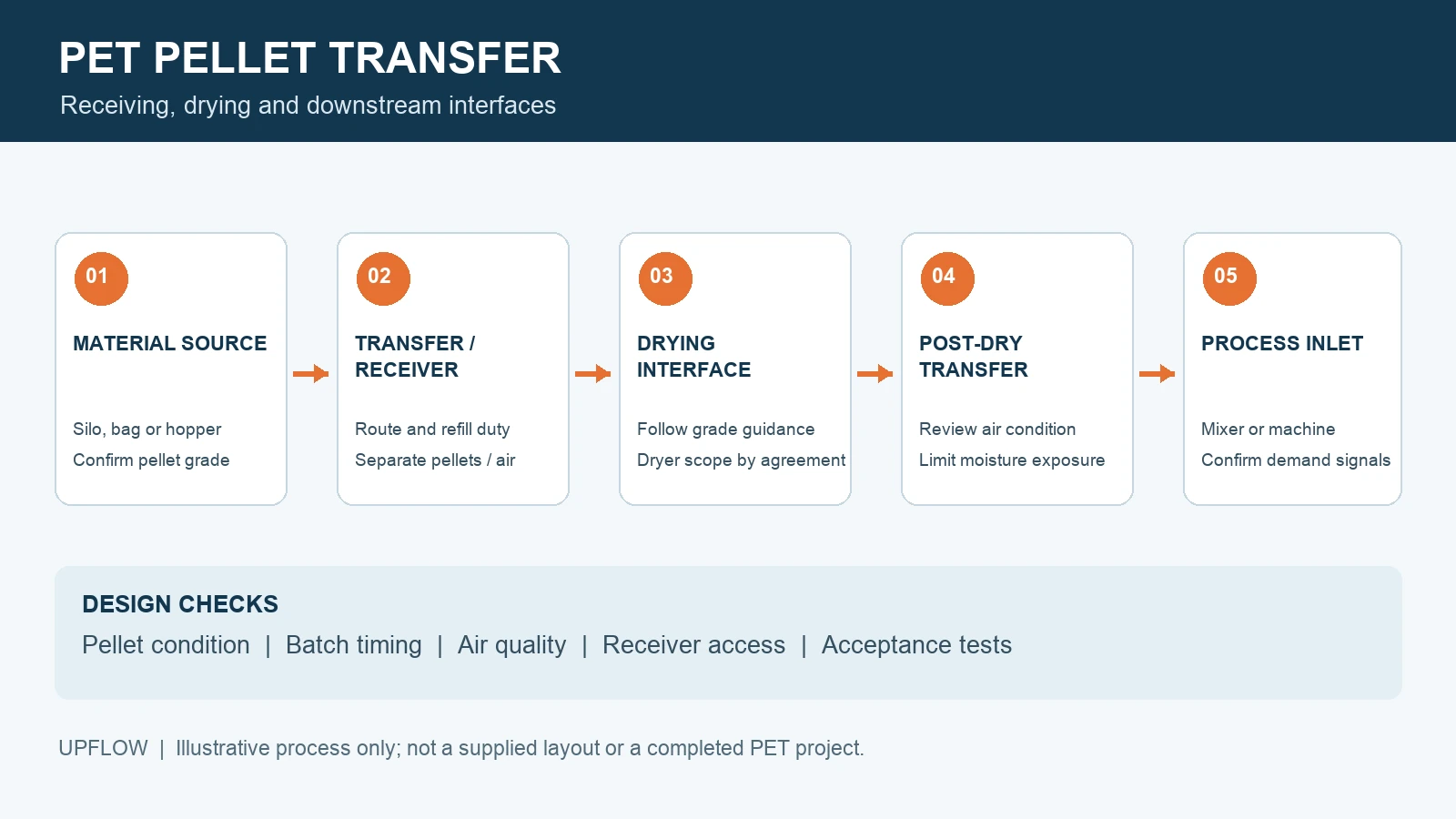
Illustrative process: receiving, drying and downstream transfer interfaces. The diagram is an original explanatory illustration, not a completed UPFLOW PET installation or a final equipment layout.
A PET pellet conveying system must match both the transfer duty and the condition required at the next process. Moving resin from storage into a drying hopper is different from moving dried pellets towards an extruder or molding machine. The second route also needs a review of conveying-air condition, waiting time and exposure at each connection.
Start with the actual PET grade, pellet dimensions, required throughput and the dryer or machine interface. Then assess the feeding arrangement, pipeline, receiver, air source and control sequence together. A conveyor capacity alone does not establish drying performance or finished-product quality.
What should a PET pellet conveying system include?
The equipment scope may include a material pickup or feeding device, conveying pipework, a receiver that separates pellets from air, an air source, filtration and demand controls. The selected arrangement must fit the source, destination and production schedule. Drying equipment, dry-air services and downstream dosing should be identified separately in the quotation.
For the wider equipment overview, see our guide to pneumatic conveying for plastic pellets and resin. This article focuses on the PET interfaces around drying and processing.
1. Identify the PET material before choosing equipment
Provide the resin supplier, grade and specification. Distinguish virgin pellets, recycled pellets, flakes and powder; they should not be treated as interchangeable feedstocks. Include pellet dimensions, bulk density, material temperature, incoming moisture information and the expected amount of fines.
If recycled content is involved, describe its form and variability rather than assuming the behaviour of a virgin resin grade. A change in pellet shape, fines or contamination can affect the suitability of a pickup device, filter or receiving arrangement.
PET drying requirements depend on the material and processing conditions. Novatec’s resin-drying guidance identifies PET as a hygroscopic resin and distinguishes crystalline material from amorphous regrind. Follow the current instructions for the supplied grade and dryer; do not use a general web article as the operating recipe for every PET material.
2. Separate the transfer before drying from the transfer after drying
| Interface | Information to confirm | Design question |
|---|---|---|
| Storage to drying hopper | Source condition, hopper capacity and refill schedule | Can the supply keep pace without disrupting the intended drying operation? |
| Dryer outlet to receiver | Pellet temperature, conveying-air condition and exposure limits | How will the transfer preserve the agreed material condition? |
| Receiver to process inlet | Inlet size, buffer volume, demand signal and discharge sequence | Can the machine receive material when needed without overflow or starvation? |
| Shared line or material change | Grade identification, residual pellets and cleaning access | How will the next grade be protected from carryover? |
For post-drying transfer, review whether the proposed air source, hoses, receiver and storage time are compatible with the required moisture condition. An enclosed pipeline does not, by itself, establish a controlled dry-air environment. Confirm the full path, including openings and pauses, with the resin and drying-equipment requirements.
3. Calculate refill duty from the production cycle
State the normal and peak material demand, the useful receiver volume and the time available for a refill. Intermittent vacuum receivers must complete their loading and discharge sequence within the available production window.
If one system serves several machines, provide the demand at each destination and explain whether simultaneous requests are possible. A total hourly figure can hide a short refill window at an individual machine. Agree on priority rules and what happens when a receiver is unavailable.
For weighing or blending, specify the dosing requirement separately. Conveying delivers resin to the next stage; it does not automatically provide the measurement and controlled discharge needed for an accurate recipe.
4. Review the route and pellet condition together
Send a marked layout showing horizontal sections, vertical lift, bends, flexible connections and destination heights. Include access for filter service, receiver inspection and line clearing. The shortest route on a drawing may still create an inaccessible connection or a difficult material change.
Establish the acceptable condition of the pellets at the destination. Where fines, pellet damage or carryover matter, define how samples will be taken and compared before and after transfer. Do not choose conveying velocity or pipe diameter from a generic pellet rule without reviewing the actual duty.
Compare a proposed vacuum conveying system or positive pressure conveying system against the same material, route and receiver requirements. Neither operating principle guarantees that every PET grade will retain its required condition.
5. Define the dryer and machine control interfaces
List the signals available from the existing equipment: material request, high level, ready to receive, discharge complete and fault status, as applicable. Agree which controller owns each step and how a loss of material supply is reported.
Include restart conditions after an interrupted batch or a blocked receiver. The operating sequence should also address grade changes and inspection access. Define these functions before ordering so that the conveyor, dryer and processing machine have compatible responsibilities.
What can a project reference demonstrate?
UPFLOW’s PVC powder feeding and vacuum conveying project shows the scope of a published conveying and receiver-integration application. It handles a different material and must not be presented as a PET installation or used as a PET capacity guarantee. For PET, define the proposed equipment and acceptance conditions against the actual resin and process.
Information to send UPFLOW for a PET conveying proposal
- PET supplier and grade, pellet dimensions, bulk density and available material specifications.
- Whether the transfer is before or after drying, plus relevant temperature and moisture requirements.
- Normal demand, peak demand, refill window and the number of destinations.
- Route drawing, elevation changes and source and receiver connection details.
- Available utilities, proposed conveying-air condition and required control interfaces.
- Acceptance checks for throughput, pellet condition, residual material and material changeover.
Use the pneumatic conveying RFQ datasheet to organize these inputs. If a conveying trial is needed, agree on the sample, test scope, measurements and limitations before shipping material.
Frequently asked questions
Can the same design convey PET pellets and PET flakes?
It requires a separate assessment. Shape, bulk density, fines and feeding behaviour can differ. Provide representative specifications and samples rather than treating both materials as the same transfer duty.
Does pneumatic conveying dry PET resin?
A transfer system should not be assumed to replace a specified drying process. Drying performance and conveying performance need separate requirements and acceptance checks.
Can dried PET be conveyed using ordinary plant air?
Do not assume it is suitable. Review air condition, pellet temperature, exposure time and the complete receiving path against the grade-specific processing requirements.
What capacity can UPFLOW quote for PET pellets?
A proposal needs the actual grade, route, elevation, operating cycle and receiver arrangement. A capacity published for another powder or project is not a verified PET rating.
Discuss your PET pellet transfer requirements
Send UPFLOW your PET pellet conveying requirements, including where the transfer sits in relation to drying and processing. These details provide the basis for evaluating a custom pneumatic conveying system and defining the equipment supply boundary.