
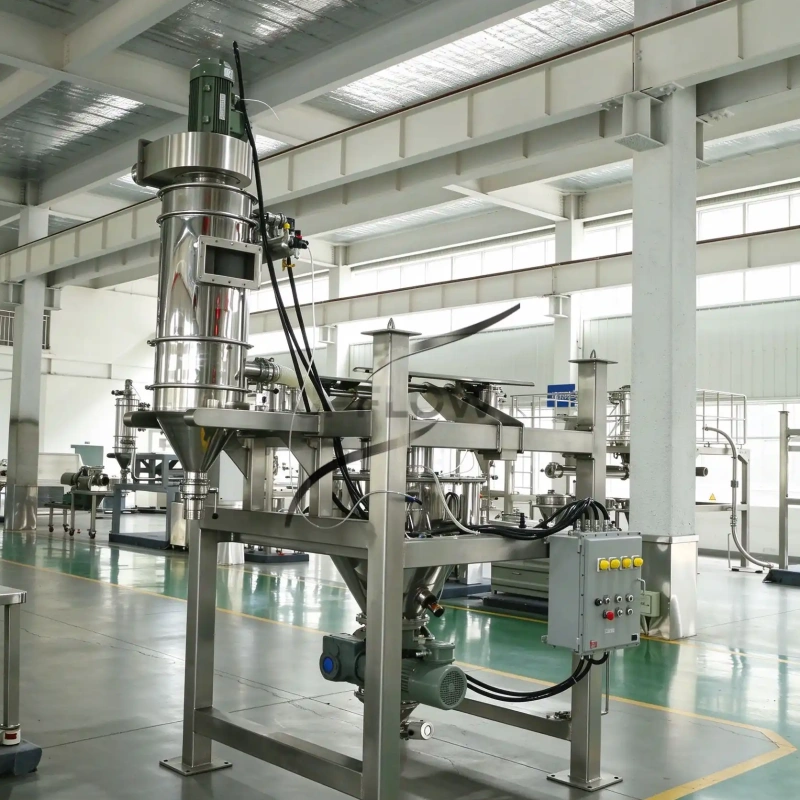
Cocoa Powder Pneumatic Conveying: Preventing Unstable Feeding and Planning for Cleaning
Cocoa powder pneumatic conveying should be specified around the actual powder grade, a stable supply to the pickup point, the complete transfer cycle and an agreed cleaning method. When delivery becomes irregular, first identify whether the interruption starts at the source, in the conveying stage or at the receiving process. Increasing airflow without that distinction may leave the original problem unresolved.
This guide addresses cocoa powder feeding to a receiving hopper or mixer. It does not cover cocoa butter, liquid chocolate or every cocoa-containing blend. Start with the complete pneumatic conveying system and define the source-to-receiver duty before selecting individual components.
Specify the cocoa grade instead of relying on the material name
Commercial cocoa powders differ in processing and composition. Record the supplier’s product code, natural or alkalized processing, declared fat and moisture content, particle-size information and storage conditions. Pure cocoa powder and a sugar-containing beverage blend should have separate material records.
Include the powder’s condition when the bag is opened: loose or compacted, visible lumps, storage duration and exposure during handling. These observations help define a representative trial. A supplier specification is useful input, but it does not replace checking how the supplied grade actually discharges and transfers in the proposed arrangement.
Use a three-location check to find unstable feeding
The original checklist below separates supply interruption from transfer interruption and downstream demand. Record the same event at all three locations so that a stopped bag outlet is not mistaken for an undersized conveying line.
| Location | Observation to record | Next check |
|---|---|---|
| Source and pickup | Does powder leave the bag or hopper consistently? When does the interruption start? | Bag condition, powder compaction, available material at pickup and the actual feed-device setting |
| Transfer and air separation | Does each transfer cycle deliver material? Does the pressure trend change? | Cycle state, route, receiver/filter condition and evidence of retained material; inspect only under the approved isolation procedure |
| Receiver and process | Does delivery arrive before usable inventory is exhausted? Is discharge permitted? | Demand timing, full/ready signals, receiving capacity and discharge sequence |
| After a stoppage | Is the next cycle equivalent to normal operation? | Dwell time, material condition, restart requirements and what remains in the route |
Record a pressure trend together with the operating state and delivered quantity. A pressure reading without knowing whether the system is picking up, conveying, discharging or waiting is difficult to interpret. For a wider symptom-based path, see our pneumatic conveying troubleshooting guide.
Match the source feed, conveying cycle and usable buffer
For bag-fed cocoa powder, the pickup point needs a controlled supply while the conveying equipment is operating. The choice of source arrangement should account for actual discharge behaviour and operator access. It should not rely on manual intervention that the production plan cannot sustain.
For an intermittent vacuum arrangement, assess delivery across suction, discharge and waiting states. Confirm that the receiving buffer covers the downstream demand and expected replenishment response. A short burst of transfer does not establish the sustained capacity of the complete line.
Compare vacuum and pressure arrangements against the route, source and destination, product requirements and trial evidence. The vacuum feeding system is one option to evaluate; it is not a universal selection for every cocoa grade, distance or throughput. Ask the proposed supplier to identify the assumptions behind the selection.
Animation: how a vacuum feeding arrangement connects the equipment
This UPFLOW animation illustrates a general vacuum feeding arrangement and its connection to receiving equipment. It is not a cocoa powder conveying trial, a cleaning demonstration or evidence of a particular throughput.
Define cleaning access and the acceptance method before ordering
List every product-contact section from the pickup to the final discharge: source connection, hose or pipe, bends, receiver, filter interfaces, valve seats and the receiving inlet. Ask which sections can be inspected or removed, which require tools and where retained powder can be checked.
The plant should define whether cleaning is dry or wet, the permitted cleaning materials, changeover requirements and the release criteria. Do not specify a wet-cleaning routine without confirming equipment compatibility and the requirements for drying and release. A stainless steel description alone does not establish cleanability or food-contact suitability.
If cocoa follows or precedes another recipe, identify colour, flavour and any relevant allergen carryover requirements for the actual ingredients. Agree the inspection or sampling method with the plant’s responsible quality team. “No visible residue” and an analytical acceptance requirement are different tests.
| Cleaning review item | Question to answer before purchase |
|---|---|
| Product-contact map | Can the operator trace and inspect the whole route, including the receiver and discharge valve? |
| Filter and seals | What is the specified material, access method and replacement or cleaning procedure? |
| Changeover | Which recipe transition is assessed, and what evidence permits production release? |
| Reassembly and restart | How are correct fitting, dryness where required and equipment-ready status checked? |
What can be learned from an existing project with another powder?
The UPFLOW PVC powder pneumatic conveying project is a different-material reference for discussing transfer and receiving interfaces. Its material is PVC, not cocoa. It does not establish cocoa food-contact suitability, cleaning performance or capacity.
Use such a reference to ask how source feeding and receiving points are coordinated, then validate the cocoa-specific requirements separately. For wider food-project procurement considerations, the food powder conveying supplier guide covers the broader selection context; this article focuses on feed stability and cleaning inputs.
A representative trial should answer these questions
Identify the cocoa grade and lot, source packaging, material condition, route, receiver and downstream demand. Observe source discharge and delivered mass over complete cycles, and record interruptions, restart behaviour and residual material. If the test differs from the production installation, state that difference in the report.
Include a cleaning-access review with the actual proposed components. Set the product-quality and cleaning acceptance requirements before interpreting the result. Have the responsible specialists assess applicable powder hazards and equipment protection; enclosed transfer alone does not establish suitability for every operating condition.
Frequently asked questions
Can one system handle different cocoa grades?
Possibly, but define the grade range and verify the limiting conditions. Keep grade identity, feeding behaviour and cleaning requirements in the trial record rather than extrapolating from the material name.
Does stronger vacuum fix irregular cocoa powder delivery?
Not necessarily. First determine whether powder is available at the pickup point and whether the receiver can accept and discharge it. Review pressure and delivery together before changing the operating condition.
What should I send for a cocoa powder conveying enquiry?
Send the material data sheet, packaging details, layout, delivery duty, receiving process and cleaning/changeover requirements. Use the RFQ input checklist to organize them, then ask UPFLOW to review the cocoa powder transfer arrangement.