
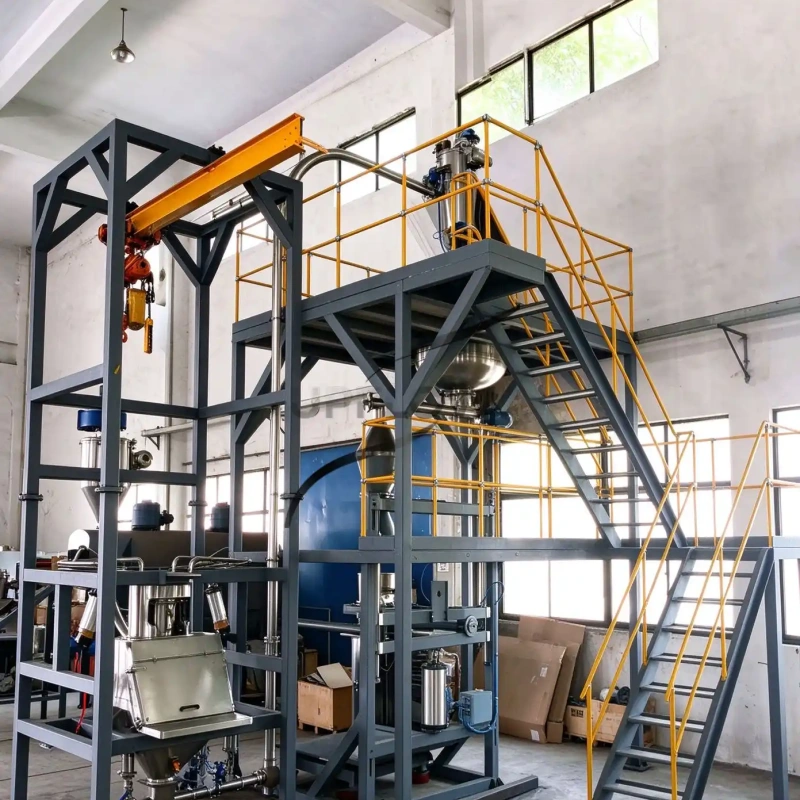
When selecting a bulk bag unloading system for industrial powder handling, one of the first equipment decisions is whether to use a hoist-mounted or forklift-loaded arrangement, because the bag loading method directly affects the required factory clearance, equipment footprint, material handling workflow, operator access and overall installation cost. Both configurations are widely applicable to FIBC (Flexible Intermediate Bulk Container) unloading operations, but their suitability depends on the existing material handling infrastructure, building conditions, bag specifications and production requirements rather than on a universal preference for one lifting method.
A hoist-mounted bulk bag unloader uses an electric hoist or an integrated lifting arrangement to raise and position the filled FIBC above the unloading frame, while a forklift-loaded bulk bag unloader relies on a forklift to lift and position the bag within the supporting structure. Understanding the differences between these two configurations helps engineers and purchasing teams select an unloading solution that fits their actual factory conditions and downstream powder handling process.
1. What Is a Hoist-Mounted Bulk Bag Unloader?
A hoist-mounted bulk bag unloader is an industrial unloading station equipped with a lifting mechanism, typically an electric hoist installed on a supporting beam or lifting structure, which allows operators to raise a filled bulk bag and position its discharge spout above the receiving hopper or unloading connection.
During operation, the FIBC bag is connected to the lifting attachment through its lifting loops, after which the hoist raises the bag to the required operating position and the operator secures the discharge spout to the unloading interface before material discharge begins.
Depending on the material characteristics and production requirements, the unloading station can incorporate additional components such as:
Structural support frame and lifting beam.
Electric hoist and lifting attachment.
Bulk bag discharge spout connection.
Bag support or internal liner arrangement.
Pneumatic bag massaging or squeezing devices, when required.
Receiving hopper and dust collection interface.
Screw feeder or rotary valve for controlled discharge.
Electrical control cabinet and pneumatic control components.
One important advantage of this configuration is that the lifting operation can be integrated into the unloading station itself, reducing dependence on a separate forklift for every bag replacement cycle when the facility has suitable overhead lifting infrastructure.
However, the hoist capacity, supporting structure, lifting path and building clearance must be evaluated according to the maximum filled bag weight and the actual lifting arrangement, rather than selecting a hoist based only on the nominal bag capacity.
2. What Is a Forklift-Loaded Bulk Bag Unloader?
A forklift-loaded bulk bag unloader uses an industrial forklift to lift a filled FIBC bag and position it onto or within the supporting structure of the unloading station, allowing the bag to be connected to the discharge system without requiring an integrated overhead hoist arrangement.
This configuration is particularly relevant to factories that already use forklifts for transporting raw materials, moving pallets and replenishing production equipment, because the existing material handling equipment can also be used for bulk bag positioning.
A typical forklift-loaded arrangement may include:
Reinforced supporting frame designed for the specified loading arrangement.
Bag lifting loops or a suitable lifting attachment.
Forklift access openings or designated lifting points.
Discharge spout connection and receiving hopper.
Dust collection and discharge control equipment.
Downstream screw feeder or conveying interface, depending on the process.
The equipment frame must be designed according to the actual load distribution and loading method, while the forklift approach direction and positioning space should be checked during the layout stage to ensure that the operator can place the bag without interfering with surrounding equipment.
Unlike a hoist-mounted arrangement, a forklift-loaded system requires the factory to maintain an appropriate vehicle access route and sufficient maneuvering space around the unloading station, which can become an important consideration in production areas with narrow aisles or multiple closely positioned machines.
3. Hoist-Mounted vs Forklift-Loaded Bulk Bag Unloaders: Key Differences
Although both configurations perform the same basic function of lifting and unloading FIBC bags, they differ in how the bag is transported, positioned and replaced, and these differences can influence the overall production workflow.
| Comparison factor | Hoist-mounted system | Forklift-loaded system |
| Bag lifting method | Electric hoist or integrated lifting device | Forklift |
| Building height | Requires evaluation of overhead lifting clearance | Depends on forklift mast and bag positioning height |
| Floor space | May require less forklift maneuvering space at the station | Requires vehicle access and turning clearance |
| Existing infrastructure | Suitable lifting structure and electrical supply required | Suitable forklift and floor access required |
| Bag positioning | Controlled through the lifting arrangement | Controlled by forklift positioning |
| Bag replacement | Hoist operation and bag connection procedure | Forklift positioning and bag connection procedure |
| Structural design | Lifting beam, hoist and supporting structure | Supporting frame and forklift loading interface |
| Maintenance | Hoist, lifting attachment and frame inspection | Frame, loading interface and forklift maintenance |
| Typical consideration | Fixed production areas with regular bag unloading | Facilities with existing forklift-based material handling |
The comparison should be interpreted in the context of the complete production process, because a forklift-loaded arrangement does not automatically require less installation space, and a hoist-mounted arrangement does not automatically provide higher unloading capacity.
The actual performance of either system depends on bag replacement frequency, operator procedures, powder discharge characteristics, downstream equipment availability and the time required to complete each unloading cycle.
4. How to Choose Between a Hoist and a Forklift Loading Arrangement
The most appropriate configuration should be determined by reviewing the factory’s existing infrastructure and the complete bag handling sequence, including the movement of incoming bags, lifting, connection, unloading, disconnection and removal of empty packaging.
4.1 Evaluate Factory Ceiling Height and Available Space
Building height is one of the first factors to review when considering a hoist-mounted bulk bag unloading station, because the lifting mechanism, lifting attachment, filled bag and unloading frame must all fit within the available vertical space.
In facilities with limited ceiling height or significant overhead obstructions, such as structural beams, ventilation ducts and existing pipelines, a conventional overhead lifting arrangement may require additional structural modifications or a different equipment configuration.
A forklift-loaded arrangement may be worth evaluating in these conditions, although the available height must still accommodate the forklift mast, filled bag and required positioning movement.
For a more detailed layout assessment, refer to UPFLOW’s technical article on bulk bag unloading and conveying system design.
4.2 Consider Existing Forklift Availability
If the production facility already operates forklifts throughout the working day and has sufficient vehicle access around the unloading station, using a forklift for bag positioning may reduce the need to install an additional integrated hoist.
However, buyers should consider whether the forklift is consistently available when the production line requires material replenishment, because sharing one vehicle among multiple material handling tasks may create operational delays during busy production periods.
For facilities with frequent bag changes or dedicated unloading areas, an integrated hoist may provide a more convenient material positioning arrangement, provided that the supporting structure and lifting system are properly designed.
4.3 Compare Bag Replacement Frequency and Operating Workflow
The total unloading cycle includes more than the time required for powder to flow out of the bag, because operators must also position the filled bag, connect the discharge spout, complete the unloading process, remove the empty bag and prepare the station for the next cycle.
For this reason, the loading arrangement should be evaluated together with the actual number of bags handled per shift and the production line’s material consumption rate.
For example, a facility that unloads several large FIBC bags during each production shift may benefit from a dedicated lifting arrangement if forklift availability is limited, whereas a facility with occasional bag replacement and an established forklift workflow may find the forklift-loaded configuration more practical.
4.4 Evaluate Floor Conditions and Structural Requirements
Both configurations require an appropriately designed supporting structure, but the load paths and installation requirements differ according to how the filled bag is lifted and supported.
For a hoist-mounted system, the lifting beam, hoist attachment and supporting frame must be evaluated for the specified loads and operating conditions, while a forklift-loaded design must consider the frame’s loading interface, support geometry and the forces generated during bag positioning.
The equipment foundation and surrounding floor conditions should also be reviewed, particularly when the unloading station is integrated with a receiving hopper, weighing equipment or downstream feeding machinery.
4.5 Consider Operator Safety and Maintenance
Operator safety should be assessed throughout the complete loading and unloading sequence, rather than focusing only on the lifting mechanism.
For hoist-mounted systems, the design and operating procedure should address suspended-load control, lifting equipment inspection, accessible controls and safe bag connection, while forklift-loaded systems should consider vehicle access, operator visibility, load stability and separation between vehicle movement and pedestrian working areas.
Both arrangements should provide appropriate access for inspecting the discharge connection, replacing filters, maintaining pneumatic components and removing accumulated powder where required.
The lifting equipment and forklift must be used within their approved rated capacities and operating instructions, with the necessary workplace risk assessment and guarding arrangements established for the actual installation.
5. Which Bulk Bag Unloading Configuration Is Better for Different Applications?
The following comparison provides a preliminary selection reference for different industrial factory conditions.
| Factory condition | Configuration worth evaluating | Main reason |
| Dedicated unloading area with suitable overhead structure | Hoist-mounted | Integrated bag lifting and positioning |
| Existing forklift material handling workflow | Forklift-loaded | Uses available material handling equipment |
| Limited forklift access around the station | Hoist-mounted | May reduce vehicle maneuvering requirements |
| Facility with restricted overhead clearance | Forklift-loaded or customized low-profile design | Avoids some overhead hoist requirements |
| Frequent bulk bag replacement | Dedicated hoist arrangement or optimized forklift workflow | Reduces dependence on shared material handling resources |
| Existing factory with established forklift routes | Forklift-loaded | Can fit the existing logistics arrangement |
| Multiple downstream feeding points | Either configuration | Depends on process layout and equipment integration |
These are preliminary engineering considerations rather than fixed selection rules, because the actual solution must also account for bag dimensions, maximum load, material flowability, dust collection, unloading capacity and the available installation area.
6. Can Both Loading Methods Be Integrated with Pneumatic Conveying Systems?
Yes. Both hoist-mounted and forklift-loaded bulk bag unloading stations can be integrated with downstream powder conveying systems, provided that the receiving hopper, feeding device and material transfer interfaces are designed according to the actual process requirements.
A typical integrated arrangement may consist of:
FIBC Bag Loading → Bulk Bag Unloading Station → Receiving Hopper → Screw Feeder or Rotary Valve → Pneumatic Conveying Pipeline → Receiving Silo or Production Equipment
The selection of downstream equipment depends on the required feeding rate, conveying distance, powder properties and the receiving equipment configuration.
For example, a screw feeder may be used to regulate powder discharge from the unloading station, while a rotary valve can provide a controlled material feeding interface for certain pneumatic conveying arrangements.
If the production process requires weighing or batch feeding, a weighing hopper or automated dosing system may also be incorporated into the overall configuration.
For additional engineering information, see the Bulk Bag Unloading and Conveying System Guide and the Anode Powder Bulk Bag Conveying System Supplier: Supply Scope.
7. Real Project References: Bulk Bag Unloading for Different Industries
Actual industrial projects provide useful references for evaluating how bulk bag unloading equipment can be configured and integrated with downstream production processes, although the lifting method and equipment dimensions must always be confirmed from the individual project drawings.
7.1 European Battery Material Manufacturer: Multiple Anode Material Unloading Systems
UPFLOW supplied multiple customized big bag unloading systems for a European battery material manufacturer, supporting the controlled feeding and transfer of anode material powders used in lithium battery production.
The published project scope includes the bulk bag supporting and unloading structure, controlled powder discharge, dust collection interface, material transfer connections and automated operating control.
This project demonstrates the importance of integrating the unloading equipment with the customer’s downstream material handling process when designing powder feeding systems for battery material applications.
Read more about the Anode Material Big Bag Unloading System Project.
7.2 Cement Big Bag Unloading and Pneumatic Conveying Project
For an industrial customer in Egypt, UPFLOW supplied a customized cement big bag unloading and pneumatic conveying solution that integrated bulk bag unloading equipment, powder feeding and pneumatic transportation.
The project illustrates how the unloading station can serve as the upstream feeding section of a complete powder handling line, where the overall equipment arrangement must consider the connection between the bulk bag discharge section, feeding equipment and downstream conveying system.
Read more about the Cement Big Bag Unloading System Project.
These projects provide practical examples of UPFLOW’s bulk material handling and equipment integration experience, but they should not be interpreted as evidence that both lifting configurations were used in each project.
8. Frequently Asked Questions
Q1. Is a hoist-mounted bulk bag unloader better than a forklift-loaded system?
Neither arrangement is universally better, because the appropriate choice depends on factory ceiling height, available lifting infrastructure, forklift availability, bag replacement frequency and the required installation layout. A hoist-mounted system may be suitable for a dedicated unloading area, while a forklift-loaded arrangement can be practical in factories with established forklift material handling operations.
Q2. Does a forklift-loaded bulk bag unloader require less installation space?
Not necessarily, because although it may avoid an integrated overhead hoist, the layout must provide sufficient space for forklift approach, positioning, maneuvering and safe operation. The complete operating envelope should be compared rather than looking only at the external dimensions of the unloading frame.
Q3. Can a bulk bag unloader be customized for low-ceiling factories?
Yes, customized configurations can be evaluated according to the available vertical clearance, bag dimensions, loading method and downstream equipment height. A low-profile arrangement or alternative lifting method may be considered when conventional overhead lifting is unsuitable.
Q4. What information is required to select a suitable lifting arrangement?
Buyers should provide the maximum filled FIBC weight, bag dimensions, lifting loop arrangement, discharge spout specifications, factory ceiling height, floor layout, available forklift or hoist equipment and the required unloading capacity. The supplier can then evaluate the equipment structure and installation arrangement against the actual working conditions.
Q5. Can the unloading station include dust collection and automatic feeding?
Yes, the unloading station can be configured with a dust collection interface, receiving hopper, screw feeder, rotary valve and downstream conveying connections according to the project scope. The required components should be defined in the technical specification and quotation rather than assuming that every unloading station includes a complete automated feeding package.
Q6. Which loading method is more suitable for frequent bulk bag replacement?
A dedicated hoist arrangement may be convenient when forklift availability is limited and the unloading station operates frequently, but the complete cycle time should be evaluated for both options, including bag positioning, connection, unloading and empty bag removal. Actual production trials and the factory’s material handling workflow provide a more reliable basis for selection than the lifting method alone.
Conclusion: Select the Bulk Bag Loading Method According to Your Factory Conditions
Choosing between a hoist-mounted and forklift-loaded bulk bag unloader requires an evaluation of the complete material handling workflow, including factory clearance, existing lifting equipment, forklift accessibility, FIBC dimensions, production frequency and downstream equipment connections.
A well-designed unloading station should not only accommodate the filled bulk bag but also provide a practical arrangement for bag replacement, controlled powder discharge, dust collection, operator access and routine maintenance throughout the production process.
UPFLOW provides customized bulk bag unloading systems and integrated powder handling equipment according to material characteristics, production capacity, installation conditions and customer requirements.
Planning a new bulk bag unloading project? Send UPFLOW your FIBC specifications, maximum bag weight, available building height, factory layout and required unloading capacity so that our engineering team can evaluate a suitable hoist-mounted or forklift-loaded configuration.
Explore the UPFLOW Bulk Bag Unloading System or contact our engineering team to discuss your project requirements.