
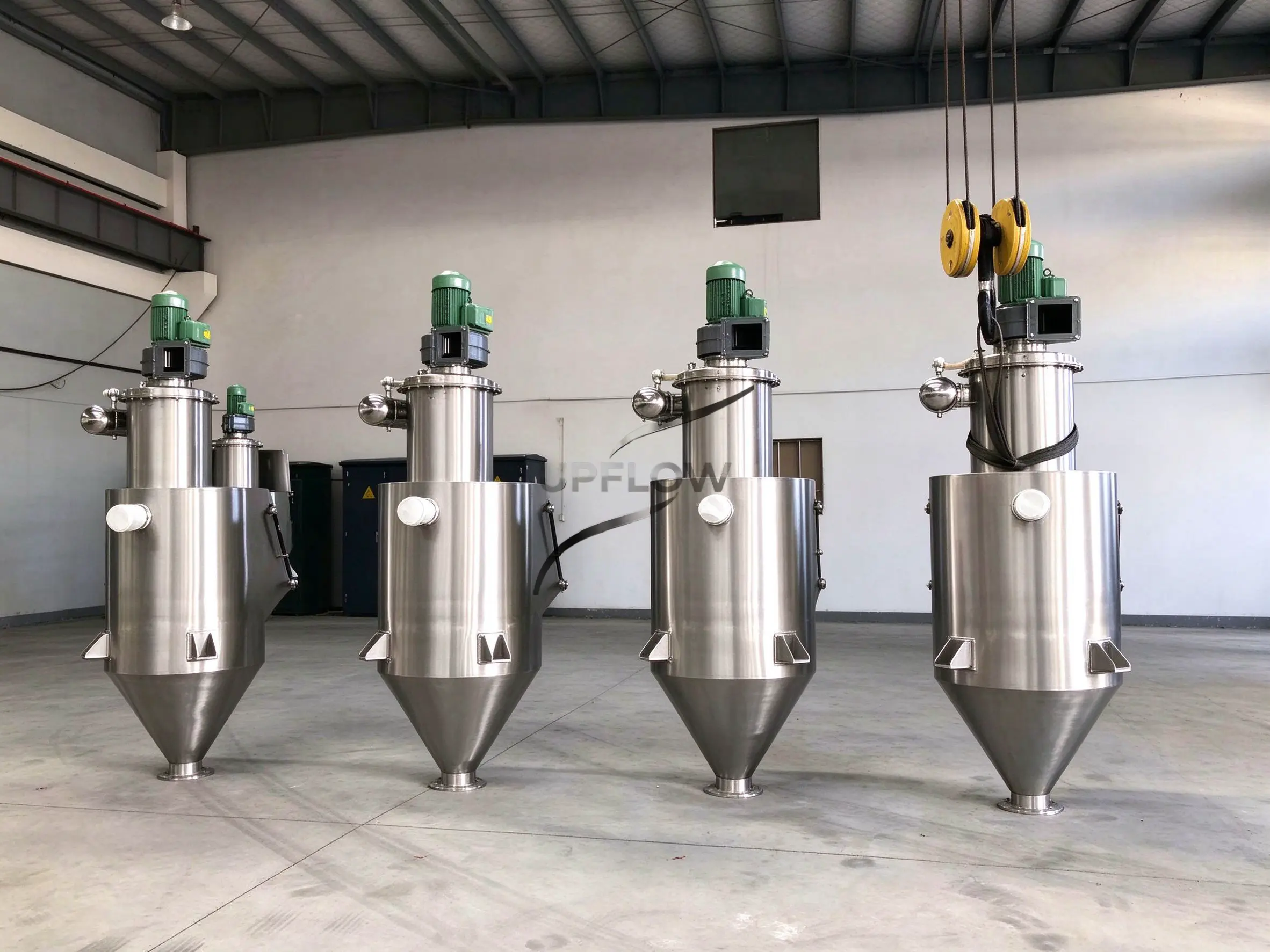
Ribbon blenders are widely used in the chemical, food, pharmaceutical, plastic and other manufacturing industries for mixing powders, granules and different dry ingredients, but achieving a stable mixing process requires more than selecting a suitable mixer capacity, because the upstream material feeding arrangement also determines how accurately raw materials can be introduced, how efficiently the mixer can be charged and how consistently the production process can operate.
For factories using 25 kg bags or other small packaging formats, a manual bag dump station can provide a practical feeding point for introducing powders into a ribbon blender, particularly when the system is designed with suitable receiving hoppers, screw feeders, weighing equipment or pneumatic conveying connections.
However, the correct arrangement depends on the required batch weight, number of ingredients, material characteristics, mixer inlet position, available installation space and production sequence, meaning that the bag dumping station and ribbon blender should be considered as parts of one integrated powder handling process rather than two independent machines.
This guide explains how to design the layout and connection between a manual bag dump station and a ribbon blender, including material feeding options, weighing arrangements, dust collection and important engineering considerations for equipment buyers.
1. Why Does a Ribbon Blender Need a Proper Bag Feeding System?
A ribbon blender typically receives different powder ingredients through one or more charging openings, and the material must be introduced according to the required batch quantity and mixing sequence before the mixing cycle begins.
When operators manually open bags and pour materials directly into the mixer, the process may become difficult to manage as the number of ingredients, batch size and production frequency increase.
Common challenges include:
Powder dust escaping during bag opening and material charging.
Inconsistent ingredient quantities caused by manual feeding.
Additional operator workload when handling multiple bags.
Difficult material transfer when the mixer inlet is located at a higher elevation.
Unstable feeding when several ingredients need to be charged within a defined production cycle.
Material accumulation around the mixer inlet and connecting equipment.
Increased cleaning requirements when different powder formulations are processed using the same production line.
A properly designed bag dump station can provide a controlled material introduction point, while suitable downstream equipment can transfer and measure the powder before it enters the ribbon blender.
For applications requiring enclosed material handling, the UPFLOW Manual Bag Dump Station can be configured with dust collection and optional screening equipment, together with connections to screw or vacuum conveying systems according to the process requirements.
2. Typical Layout of a Bag Dump Station Connected to a Ribbon Blender
The overall equipment arrangement should be developed according to the relative elevations of the bag dumping station, receiving hopper, conveying equipment and ribbon blender, because the available installation height and material transfer distance directly influence the most suitable feeding configuration.
A typical powder feeding process may follow:
Manual Bag Dump Station → Receiving Hopper → Screw Feeder or Vacuum Conveyor → Ribbon Blender
For applications requiring automatic ingredient weighing, the arrangement may be extended to:
Manual Bag Dump Station → Feeding Hopper → Weighing Hopper → Controlled Discharge → Ribbon Blender
The main equipment components may include:
| Equipment | Main function | Important design consideration |
| Manual bag dump station | Introduces bagged powders into the process | Operator access and dust containment |
| Receiving hopper | Temporarily holds incoming material | Working volume and discharge geometry |
| Vibrating screen | Removes selected oversized particles | Mesh aperture and screening capacity |
| Screw feeder | Provides controlled powder discharge | Feeding rate and material flowability |
| Vacuum conveying system | Transfers powder through enclosed pipelines | Conveying distance and receiving arrangement |
| Weighing hopper | Measures ingredient quantities | Required batch tolerance and weighing sequence |
| Ribbon blender | Mixes different ingredients | Batch capacity and charging sequence |
| Dust collector | Captures airborne powder | Extraction airflow and filter selection |
The actual arrangement does not need to include every component, because a simple feeding application may only require a manual bag dump station and a receiving hopper, while a multi-ingredient production line may require several weighing and feeding units.
3. How to Choose the Connection Method Between the Bag Dump Station and Ribbon Blender
The most appropriate feeding method depends on the installation height, horizontal transfer distance, material characteristics, required feeding capacity and whether the production process needs accurate batch weighing.
Three common arrangements can be considered.
3.1 Direct Gravity Feeding
Gravity feeding can be a practical solution when the bag dumping station is installed above the ribbon blender and the material can move directly through a suitable chute or connecting hopper.
In this configuration, the powder enters the receiving section after manual bag discharge and moves toward the ribbon blender through gravity, reducing the number of mechanical conveying components required between the two machines.
However, the equipment elevation must be carefully coordinated, because the feeding station needs sufficient height for operator access, bag handling and the receiving structure, while the ribbon blender must remain accessible for operation, inspection and maintenance.
Gravity feeding is generally worth evaluating when:
The ribbon blender is located below the bag dumping station.
The powder has suitable flow characteristics.
The transfer route is relatively short.
The process does not require a complex intermediate weighing arrangement.
The available factory height can accommodate the complete installation.
For cohesive powders, the hopper outlet and chute geometry should be reviewed carefully, because gravity alone may not provide stable material discharge if bridging or material accumulation occurs.
3.2 Screw Conveyor or Screw Feeder Connection
A screw feeder or screw conveyor is commonly considered when the bag dumping station and ribbon blender cannot be connected through a direct gravity arrangement or when the process requires controlled mechanical material transfer.
The powder is first discharged into a receiving hopper, after which the screw equipment transfers it toward the ribbon blender inlet.
This configuration allows the equipment designer to coordinate the feeding direction, discharge height and transfer rate according to the actual factory layout.
The following points should be evaluated:
Screw diameter and effective conveying length.
Material bulk density and flowability.
Required feeding capacity.
Inclination angle and installation position.
Motor and drive accessibility.
Sealing requirements at the receiving and discharge interfaces.
Cleaning and maintenance access.
For applications requiring controlled ingredient feeding, a variable-frequency drive can be considered to adjust the screw operating speed, although the actual feeding accuracy depends on the equipment design and whether a separate weighing arrangement is provided.
3.3 Vacuum Pneumatic Conveying Connection
Vacuum conveying can be a suitable alternative when the ribbon blender is installed at a considerable distance from the manual feeding station or when powder needs to be transported through an enclosed pipeline to an elevated receiving point.
In this arrangement, the powder enters the vacuum conveying system through the bag dumping station and is transported through a pipeline toward a receiver installed above or near the ribbon blender.
The receiver can then discharge the material into the mixer according to the production sequence.
A typical arrangement includes:
Manual bag dump station with dust collection.
Vacuum conveying pickup or feeding connection.
Conveying pipeline and bends.
Vacuum receiver with filtration.
Discharge valve or controlled feeding device.
Ribbon blender charging inlet.
The conveying equipment should be selected according to the material characteristics, conveying distance, elevation, required capacity and receiver configuration rather than assuming that one vacuum conveying unit can handle every powder and mixer arrangement.
For more information, see the UPFLOW Pneumatic Conveying System, which can be evaluated for enclosed powder transportation between manual feeding stations and downstream production equipment.
4. How to Integrate Weighing and Batch Feeding
When a ribbon blender processes multiple ingredients according to a defined recipe, the feeding system should provide a clear method for determining how much of each material enters the mixer.
Simply connecting a bag dump station to a ribbon blender does not guarantee accurate batch dosing, because the quantity of powder discharged from each bag may not correspond to the actual recipe requirement.
There are several possible weighing arrangements.
4.1 Weighing Before the Ribbon Blender
A separate weighing hopper can be installed between the bag dumping station and the ribbon blender, allowing each ingredient to be measured before being discharged into the mixer.
The operating sequence may follow:
The operator introduces the first ingredient through the manual bag dump station.
The material enters the weighing hopper through a suitable feeding arrangement.
The weighing system measures the required quantity.
Once the target weight is reached, the discharge valve releases the ingredient into the ribbon blender.
The same process is repeated for the remaining ingredients according to the recipe.
This arrangement can provide a clear weighing boundary and make it easier to manage multiple ingredients within a batch.
4.2 Weighing the Complete Feeding Assembly
In certain applications, the receiving hopper or feeding assembly may be installed on load cells, allowing the system to determine the material quantity through weight changes during filling or discharge.
However, the supporting structure, flexible connections and connected pipelines must be designed so that external mechanical forces do not interfere with the weighing measurement.
4.3 Automated Batching Integration
For production lines handling several ingredients with different target quantities, a centralized Automated Batching System can be considered to coordinate weighing, feeding and discharge according to the production recipe.
The control system may manage ingredient identification, target weights, feeding sequence, discharge confirmation and the interface with the ribbon blender.
The required batch tolerance, weighing sensor specification and control logic should be defined according to the customer’s production requirements rather than assuming that the same weighing configuration is suitable for every application.
For further information about integrating material transfer with weighing and controlled feeding, see UPFLOW’s Magnesium Silicate Pneumatic Conveying System, which discusses the relationship between manual feeding, enclosed transportation and automatic batching.
5. Dust Collection at the Bag Dumping and Mixer Charging Points
Dust collection is an important consideration when designing a bag dumping and ribbon blender feeding system, particularly when the raw materials are fine powders that can become airborne during bag opening, material tipping and equipment disconnection.
The dust collection arrangement should be evaluated at both the manual feeding station and the mixer charging interface, because dust generated during bag dumping may behave differently from powder displaced by incoming material at the ribbon blender inlet.
5.1 Dust Collection at the Manual Bag Dump Station
The bag dumping station should provide a suitable enclosed working area and extraction connection so that airborne powder generated during bag opening and tipping can be captured.
The required airflow depends on the access opening, operator movements, powder characteristics, extraction ductwork and filter resistance.
A properly selected dust collector should maintain suitable extraction performance during the actual feeding operation rather than relying only on the fan’s nominal maximum airflow.
5.2 Dust Control at the Ribbon Blender Inlet
When powder enters a ribbon blender, the incoming material displaces air within the receiving space, and fine particles may escape through the charging opening if the connection and ventilation arrangement are not properly designed.
Depending on the mixer configuration, the system may require a suitable dust extraction connection, enclosed charging chute or another controlled venting arrangement.
The design should consider the mixer manufacturer’s recommended charging arrangement and avoid creating an unsuitable pressure condition inside the mixer.
5.3 Coordinate Dust Collection with the Complete Process
Where the bag dump station, conveying receiver and ribbon blender use separate dust collection points, the extraction arrangements should be evaluated together to avoid unintended airflow interference or excessive air leakage.
The dust collector selection should consider the number of active extraction points, operating sequence, duct resistance and filtration requirements.
For a more detailed discussion, see Bag Dump Station Dust Collector Sizing: Airflow and Filter Selection.
6. How to Design the Equipment Layout Around the Ribbon Blender
The layout should provide a practical route from the incoming bagged material to the ribbon blender while leaving sufficient space for operators, material replenishment, cleaning and equipment maintenance.
Several dimensions should be confirmed before finalizing the equipment drawings.
6.1 Relative Equipment Elevation
The height of the bag dumping station, receiving hopper, weighing equipment and ribbon blender inlet should be coordinated during the initial layout stage.
For gravity feeding, the available vertical height is particularly important, whereas screw and vacuum conveying arrangements provide additional flexibility when the mixer inlet cannot be positioned directly below the feeding station.
6.2 Horizontal Distance and Pipeline Routing
When the feeding station and mixer are installed in different locations, the transfer route should be evaluated according to the selected conveying method.
For pneumatic conveying, the pipeline should consider conveying distance, elevation changes, bends, material properties and receiver location.
For screw conveying, the equipment length, inclination, support structure and drive access should be considered.
6.3 Operator Access and Material Replenishment
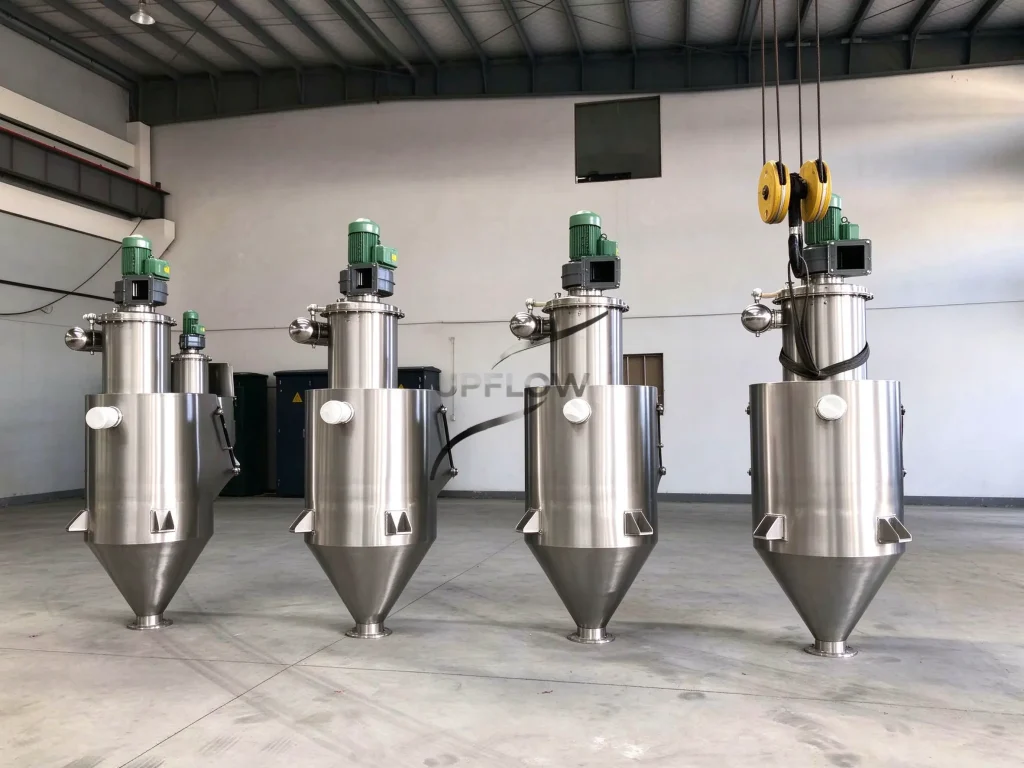
The manual bag dump station needs sufficient space for operators to position, open and empty bags, while the incoming material pallets and empty packaging collection area should not obstruct the working zone.
The layout should also provide access to the mixer inspection cover, charging inlet, discharge valve and maintenance components.
6.4 Cleaning and Material Changeover
When one ribbon blender processes multiple powder formulations, cleaning and material changeover requirements should be considered during the equipment selection stage.
The receiving hopper, screw feeder, conveying pipeline and connecting components should be designed according to the required cleaning procedure, particularly when the production process involves different materials with contamination-control requirements.
For further information about planning manual feeding equipment dimensions and operator access, see 25 kg Bag Dump Station Design: Hopper Size, Work Height and Dust Capture.
7. Typical Bag Dump Station and Ribbon Blender Connection Arrangements
The following configurations illustrate how different feeding arrangements can be selected according to production requirements.
| Application | Recommended arrangement to evaluate | Main consideration |
| Small production batches | Bag dump station → receiving hopper → gravity discharge | Simple layout and material flow |
| Controlled continuous feeding | Bag dump station → screw feeder → ribbon blender | Stable feeding rate |
| Elevated mixer inlet | Bag dump station → vacuum conveying → receiver → blender | Vertical transfer and pipeline routing |
| Multiple ingredients | Bag dump station → weighing hopper → controlled discharge → blender | Recipe accuracy |
| Multiple material sources | Multiple feeding stations → weighing or conveying system → blender | Material identification and control |
| Fine powder applications | Enclosed bag dump station → dust-controlled transfer → blender | Dust containment and filtration |
The final arrangement should be determined by the mixer inlet design, required batch capacity, material characteristics and actual factory installation conditions.
8. UPFLOW Project References: Integrated Powder Feeding and Mixing
8.1 Magnesium Silicate Pneumatic Conveying and Batching System
UPFLOW supplied a customized magnesium silicate pneumatic conveying and batching system for an overseas industrial customer, integrating manual bag dumping, pneumatic conveying, material receiving, weighing hoppers, screw feeding equipment and centralized control.
The project demonstrates how a manual bag dumping station can serve as the starting point of an integrated powder feeding and batching process, in which material introduction, enclosed transportation and controlled feeding are coordinated according to the production requirements.
Although the project is not presented as a ribbon blender installation, its equipment integration approach provides a relevant reference for evaluating the connection between bag dumping, weighing and downstream powder processing.
Read more about the Magnesium Silicate Pneumatic Conveying and Batching System Project.
8.2 PVC Powder Feeding and Vacuum Conveying System
For a new materials manufacturer, UPFLOW supplied a customized PVC powder feeding and vacuum conveying system incorporating bag unloading equipment, vacuum conveying units, stainless steel pipelines, receiving hopper modifications, dust collection connections and centralized electrical control.
The system was designed to transfer PVC powder from the bag unloading area to multiple downstream receiving points, demonstrating the importance of coordinating the upstream feeding station with the actual layout and interfaces of existing production equipment.
This project provides a practical reference for manufacturers planning to connect a bag dumping station with remote processing equipment, although the actual receiving equipment and production process should be evaluated separately for each ribbon blender application.
Read more about the PVC Powder Feeding and Vacuum Conveying System Project.
These project references demonstrate UPFLOW’s experience in customized powder feeding, conveying and batching integration, but they should not be interpreted as evidence that either project used a ribbon blender or the exact connection configuration described in this article.
9. What Information Should Buyers Provide When Requesting a Bag-to-Blender Feeding System?
To prepare a suitable equipment proposal, buyers should provide the basic information about the ribbon blender, raw materials, feeding requirements and available installation space.
| Required information | Details to provide | Engineering purpose |
| Ribbon blender capacity | Working volume and batch weight | Determine material feeding requirements |
| Mixer inlet | Inlet dimensions, position and elevation | Design the connection |
| Material information | Material name, particle size and bulk density | Select feeding method |
| Packaging | Bag size and weight | Configure the manual feeding station |
| Number of ingredients | Material types and recipe quantities | Determine batching requirements |
| Feeding capacity | Required loading time or production rate | Select transfer equipment |
| Conveying distance | Horizontal distance and vertical elevation | Evaluate screw or pneumatic conveying |
| Factory layout | Floor plan and equipment positions | Prepare installation arrangement |
| Dust requirements | Enclosure and filtration requirements | Configure dust collection |
| Cleaning requirements | Material changeover and cleaning method | Select suitable equipment structure |
Providing this information helps the supplier determine whether the application is better served by gravity feeding, screw conveying, vacuum conveying or an integrated weighing and batching system.
10. Frequently Asked Questions
Q1. Can a manual bag dump station feed directly into a ribbon blender?
Yes, direct feeding can be considered when the bag dumping station is installed above the ribbon blender and the material can move through a suitable gravity connection. The arrangement should provide adequate operating height, suitable material flow and access for cleaning and maintenance.
Q2. Is a screw feeder or vacuum conveyor better for feeding a ribbon blender?
Neither method is universally better, because screw feeders provide mechanical material transfer and can support controlled feeding, while vacuum conveying is useful when powders need to be transferred through enclosed pipelines to remote or elevated receiving points. The appropriate selection depends on the material, distance, required capacity and process arrangement.
Q3. How can multiple ingredients be added accurately to a ribbon blender?
A separate weighing hopper or integrated automated batching system can be used to measure and discharge each ingredient according to the production recipe. The weighing location, required batch tolerance and control sequence should be defined before the equipment is designed.
Q4. Does a ribbon blender feeding system need a dust collector?
Dust collection may be necessary when handling fine powders, because dust can be generated during manual bag opening, material transfer and mixer charging. The extraction arrangement should be evaluated according to the powder characteristics, enclosure design and actual operating conditions.
Q5. Can a bag dump station feed multiple ribbon blenders?
Yes, a customized feeding system can be designed to supply multiple receiving points, but the arrangement needs to consider material routing, valve selection, conveying capacity, equipment interlocks and the production sequence to prevent incorrect material delivery.
Q6. What is the difference between a bag dump station and an automatic batching system?
A manual bag dump station provides an operator-controlled location for introducing bagged materials into the process, whereas an automated batching system manages the weighing and controlled feeding of ingredients according to a defined production recipe. The two systems can be integrated when a production line requires both manual bag handling and accurate batch control.
Q7. What drawings should be provided for a ribbon blender feeding system quotation?
Buyers should ideally provide the ribbon blender general arrangement drawing, inlet and outlet dimensions, mixer working capacity, factory layout, bag dimensions, material specifications and required feeding sequence. These documents allow the supplier to evaluate equipment elevation, transfer connections and maintenance access before preparing the final layout.
Conclusion: Design the Bag Feeding and Ribbon Blender as One Integrated Process
A reliable bag dump station for feeding a ribbon blender should be designed around the complete material handling sequence, because the relationship between manual bag discharge, receiving hoppers, weighing equipment, conveying connections and mixer charging determines whether the production line can operate smoothly and consistently.
Gravity feeding may be appropriate for simple installations with sufficient vertical clearance, while screw feeders and vacuum conveying systems can provide more flexibility when the mixer is positioned remotely or at a different elevation; for multi-ingredient production, a suitable weighing and batching arrangement should also be considered to ensure that each material enters the mixer according to the required recipe.
UPFLOW provides customized manual bag dump stations, pneumatic conveying systems, automatic batching equipment and integrated powder handling solutions according to material characteristics, production capacity and factory layout.
Planning a bag dumping and ribbon blender feeding system? Send UPFLOW your mixer drawings, material specifications, batch requirements and factory layout so that our engineering team can evaluate a suitable feeding and connection arrangement.
Explore the UPFLOW Manual Bag Dump Station, the Pneumatic Conveying System or contact our engineering team to discuss your project requirements.