
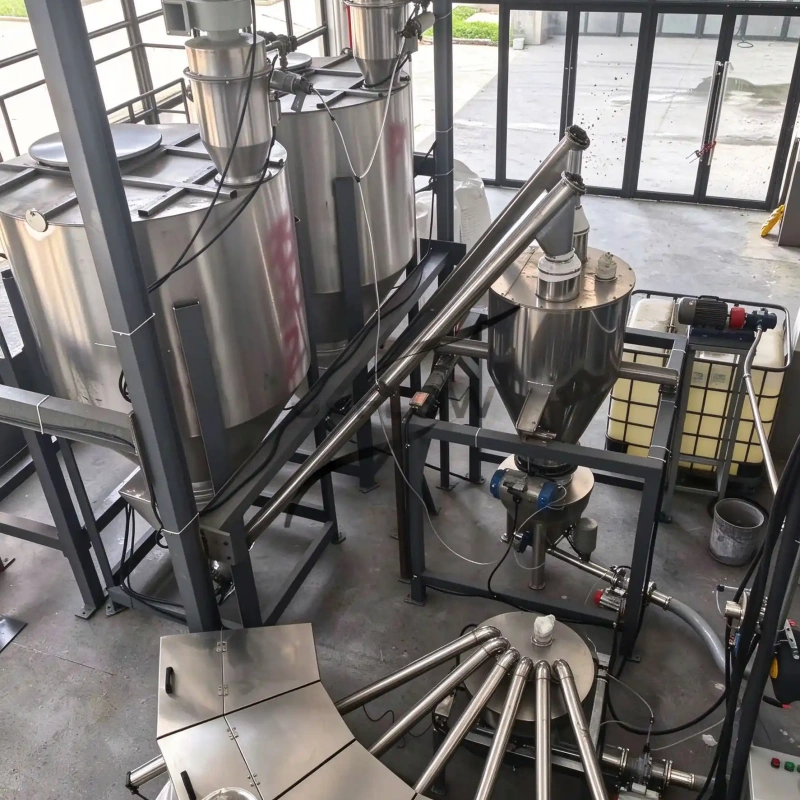
Plastic Pellet Pneumatic Conveying: Preventing Material Mix-Ups During Changeovers
Preventing material mix-ups during plastic pellet pneumatic conveying requires two separate checks: confirm the intended source-to-machine connection, then verify that the shared path is ready for the next resin. A correct recipe on the screen does not establish that a hose is connected to the correct outlet or that the receiver is free of the previous material.
This guide focuses on changeovers at distribution stations and shared receiving points. For the wider central-feeding arrangement, see our plastic pellet conveying system overview. The worksheet below is a planning tool, not evidence that every installation includes automatic material verification.
Separate wrong routing from retained material
Wrong routing means that a source supplies the wrong destination. Retained material means that the intended route still contains pellets, fines or residues from the previous run. Both can lead to an unwanted blend, but they require different checks. Changing a hose connection does not clean the line, and clearing the line does not verify the destination.
Define the boundary before writing a procedure: source bin or dryer, pickup, hose, distribution connection, common pipe, receiver and the process hopper below it. Include removable adapters and temporary hoses. Where regrind or masterbatch is introduced separately, identify that connection as a separate material source.
Build a source-to-destination connection register
Give each physical source, connection and destination a stable identifier. Put the same identifier on the drawing, the installed connection and the operating record. Resin grade, colour and lot can change while the equipment identifier remains fixed. Do not rely on colour labels alone when multiple grades have similar appearance.
| Field | Example identifier or entry | Verification |
|---|---|---|
| Source equipment | S-01: dryer outlet | Match the physical outlet to the current material label |
| Material identity | Grade / colour / lot: enter actual data | Compare the supply label with the production order |
| Distribution connection | M-01 → R-03 | Trace both ends of the hose or fixed route |
| Destination | R-03 receiver above machine H-03 | Confirm the receiving process and current order |
| Shared sections | List the common pipe, receiver and adapter | Identify what must be cleared or cleaned |
| Release record | Operator / reviewer / time / exceptions | Follow the plant’s approved release responsibility |
The example identifiers above are invented to demonstrate the format; they do not describe an UPFLOW customer installation. Attach a marked-up drawing or photographs of the actual connection points. Include blank or unused ports so they cannot be mistaken for approved alternative routes.
Use a defined changeover sequence
- Confirm the next job. Check the required resin grade, colour, lot and receiving machine before moving a connection.
- Stop replenishment from the old source. Put affected equipment into the approved changeover state and identify any downstream stock that remains.
- Clear and inspect the agreed material path. Use the equipment supplier’s procedure and the plant’s isolation rules before opening equipment. Record inaccessible sections instead of assuming they are empty.
- Reconnect and verify the route. Match the connection register to the physical source, distribution port and destination. Record any temporary arrangement.
- Check the first received material. Use the plant’s sampling and release method before routine production resumes. Record the sample location and disposition of the initial material.
A line-clearing cycle can remove conveying material from part of the route, but it is not automatically a validated cleaning process. The required method depends on resin compatibility, colour sensitivity, retained material and product requirements. Define where cleared pellets are collected and how they are identified; do not automatically return an unidentified mixture to usable stock.
Specify what the controller can actually verify
A demand signal only asks for material. It may not prove which resin is connected. During procurement, ask which of the proposed pneumatic conveying system interfaces are checked automatically and which still require operator confirmation.
A useful cause-and-effect review covers an incorrect source selection, an unconfirmed connection, a receiving-high-level signal and a changeover that has not been released. Specify whether the response inhibits loading, raises an alarm or requires a documented operator action. Do not describe barcode, RFID or connection sensing as supplied features unless they are explicitly included in the quotation.
Check the receiving end as well as the distribution station
Pellets may remain in the receiver, process hopper or downstream feeding equipment after the conveying pipe has been cleared. Agree who owns each boundary and whether material below the receiver must be emptied separately. If the receiver is being added to existing equipment, use the receiver-to-hopper retrofit checklist to review discharge, access and control responsibilities.
Our Korea vacuum-feeding project is a separate reference for integrated feeding equipment. It is not evidence of plastic-pellet changeover performance or a supplied material-proofing function.
Watch the material pickup and receiving equipment
The UPFLOW video below demonstrates vacuum transfer equipment for powders and granules. Use it to identify the pickup and receiving boundaries discussed in the checklist. It is not a demonstration of automatic resin identification or a validated changeover procedure.
Watch this video on UPFLOW’s YouTube channel.
FAQ
Does a dedicated line eliminate every mix-up risk?
A dedicated route reduces sharing, but its source identity, destination and any temporary connections still need verification. Maintenance changes and material labels should remain part of the release check.
Can two resin grades use the same line?
Potentially, when the plant has agreed compatibility, clearing or cleaning, sampling and release requirements. The acceptable arrangement depends on the actual grades and finished-product requirements, not only pellet size.
What should be included in a changeover enquiry?
Send the resin and colour list, source/destination register, shared-route drawing, current procedure and required verification functions. The pneumatic conveying RFQ datasheet helps organise the equipment and route details.
Review your material-changeover arrangement
Send UPFLOW your connection layout and describe where the current changeover check is uncertain: source identity, hose routing, retained material or receiving-end release.