
PVC Powder Vacuum Conveying Test: What to Record Before Requesting a Quote
A useful PVC powder vacuum conveying test record identifies the powder, the complete test route, the operating sequence and the actual delivered mass over a defined time. A short video of powder moving demonstrates an observed transfer step; it does not by itself establish a guaranteed production rate or performance on a different route.
This article provides a test-record worksheet for discussing an initial quotation. For the conveying methods themselves, use our PVC powder pneumatic conveying overview. Keep the material evaluation and the final site acceptance conditions clearly connected.
Start with the actual PVC powder sample
Record the supplier, resin grade or blend designation, lot, packaging and sample quantity. State whether the material is neat resin or a formulated mixture containing additives. Include available particle-size, bulk-density and moisture information, with the measurement method or supplier document identified. If a value is unknown, mark it unknown rather than borrowing a typical number from another powder.
Describe the condition of the sample when received and when tested: storage, visible lumps and any conditioning or screening. Keep a retained reference sample when the agreed procedure requires it. An unrecorded change in sample condition makes a later comparison harder to interpret.
Watch UPFLOW’s PVC manual-feeding test
The video below is published on UPFLOW’s channel as a PVC powder vacuum conveying test for manual feeding. The channel description identifies it as customer-material evaluation with powder introduced manually and transferred through the conveying equipment. The public clip is a qualitative reference, not a complete test report with delivered mass, route resistance and repeated-cycle results.
Watch this video on UPFLOW’s YouTube channel.
When reviewing the footage, distinguish what is shown from what needs a written record. Ask how powder was supplied to the pickup, where it was received, what happened between cycles and whether any interruption occurred outside the filmed portion. Do not calculate kilograms per hour from the video’s running time.
Complete a PVC powder conveying test report
| Record group | What to enter | Why it matters |
|---|---|---|
| Material identity | Grade/blend, lot, sample quantity, condition and documents | Links the result to a defined PVC sample |
| Source feeding | Manual or controlled feed, pickup position, interruptions | Distinguishes transfer capability from source availability |
| Route | Pipe/hose bore, horizontal length, lift, bends and flexible sections | Defines what was actually tested |
| Equipment | Receiver/filter, vacuum source, discharge device and settings | Makes the proposed configuration traceable |
| Measurement boundary | Start/stop events, weighing location and elapsed-time basis | Prevents different rates from being compared as equivalent |
| Repeated runs | Delivered mass, elapsed time, discharge/wait periods and exceptions | Shows repeatability and cycle limitations |
| Product and housekeeping | Samples, visible retention, filter checks and observed dust escape | Records checks beyond whether powder moves |
| Acceptance and gap list | Agreed criteria, deviations, untested site conditions and responsibilities | Prevents a successful trial being overstated |
The worksheet is an original planning aid. It contains no measured results and does not claim that every item can be determined from the public video. Agree beforehand which measurements the supplier will provide and which require a separate witnessed test.
Define capacity using the full delivery cycle
State whether a quoted rate measures active suction time or total elapsed time until material is available downstream. Receiver discharge, waiting for the receiving equipment and manual source replenishment may affect the useful delivery rate. Use the full-cycle vacuum conveying capacity method to keep those time boundaries explicit.
Illustrative calculation, not an UPFLOW test result: if a hypothetical test delivers 20 kg in 120 seconds including its discharge and waiting steps, the elapsed-time average is 20 ÷ 120 × 3,600 = 600 kg/h for that recorded interval. This arithmetic does not establish continuous production capacity, a suitable equipment model or a guaranteed result for PVC powder.
Record several agreed runs rather than selecting the fastest one. Note changes in source level, filter condition, receiving permission and retained powder. State how weighing accuracy and timing were checked so the result can be interpreted correctly.
Compare the trial arrangement with the proposed production line
A quotation should identify differences between the trial and the site: route length and lift, number of bends, pickup arrangement, receiving points, available utilities and downstream refill windows. Ask which differences require further testing or engineering review.
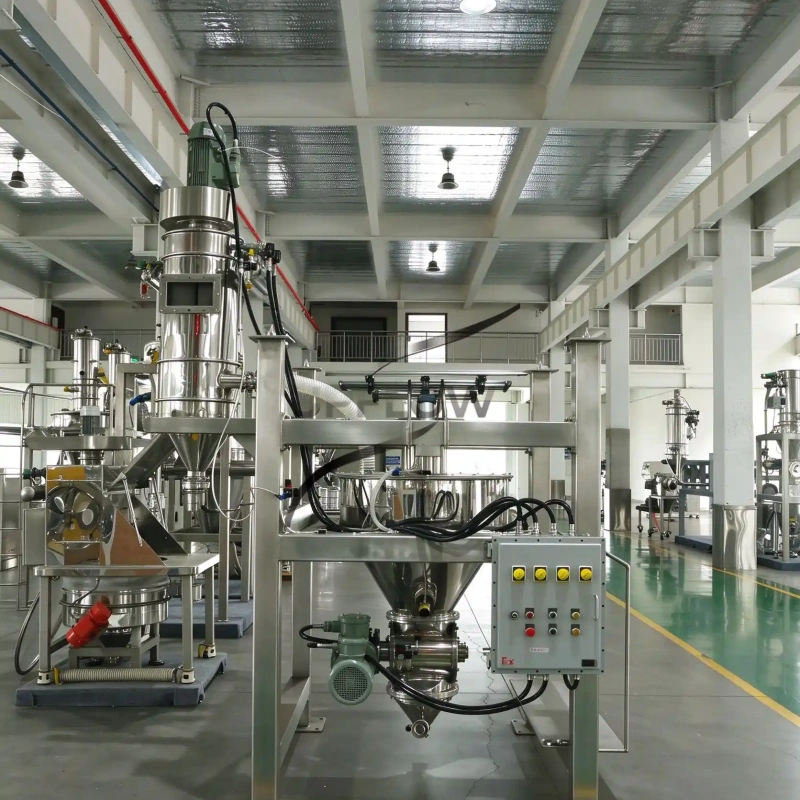
UPFLOW’s published PVC powder feeding and vacuum conveying project is a separate installation reference involving multiple equipment interfaces. Do not assume that this project and the test video show the same customer, route or capacity.
Discuss how the proposed pneumatic conveying system connects the source, receiver and downstream process. Assign responsibility for support, dust-extraction interfaces, controls and commissioning. A powder trial does not replace the plant’s assessment of material hazards, required protection or equipment suitability.
Turn the results into an enquiry package
Send the completed test sheet with the material documents, actual route drawing, required delivery window and receiving-equipment details. Mark untested items clearly. Use the RFQ datasheet to separate supplied equipment from site work and required evidence.
FAQ
Does smooth transfer in a video prove the required capacity?
No. A meaningful capacity statement needs measured mass, a defined elapsed time, the material identity and the tested configuration. The video can support discussion of the sequence without replacing those records.
Should every PVC grade be treated as the same material?
No. Record the actual grade or blend and its relevant handling properties. State how any proposed substitution differs from the tested sample.
What if the test route is shorter than the production route?
Record the difference and ask for the engineering basis of the proposed configuration. Further testing may be appropriate; the short-route observation should not be presented as proof of performance over the longer route.
Discuss a PVC powder conveying trial
Contact UPFLOW with your PVC sample details and route drawing so the proposed test conditions and quotation scope can be agreed before performance claims are made.