
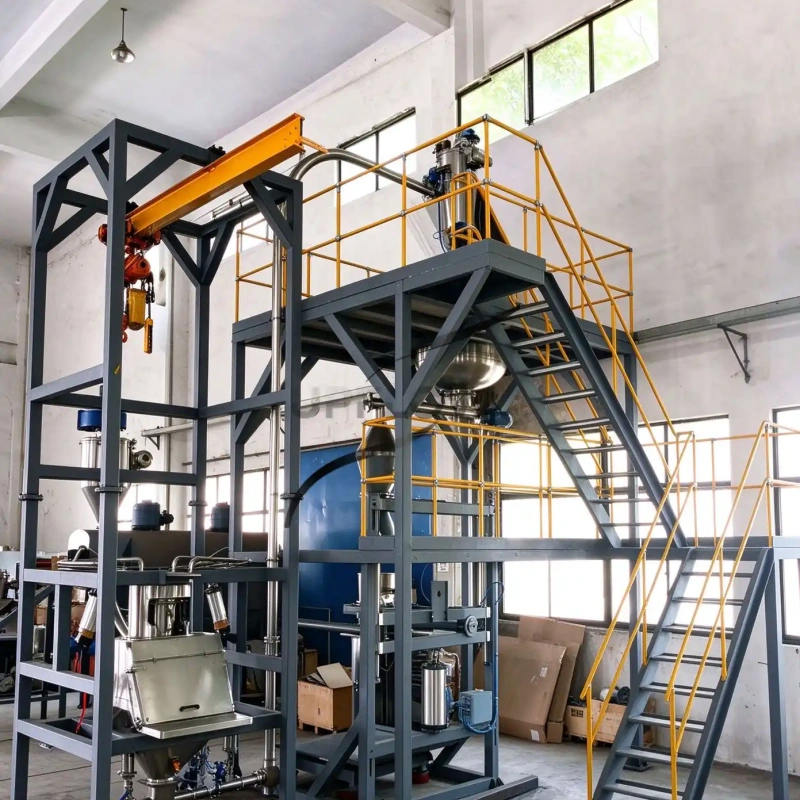
Flour Pneumatic Conveying to Mixers: Bag Feeding and Refill Interfaces
A flour pneumatic conveying system should deliver flour within the mixer’s permitted refill window while keeping bag unloading, air separation and batch weighing coordinated. Start with where the flour is weighed and when the mixer can accept it. An hourly transfer target alone cannot define the receiver, discharge arrangement or controls.
This guide focuses on bag-fed flour transfer to a mixer or its buffer hopper. It covers the handover points between equipment, rather than a general food-powder supplier comparison. Wholemeal flour, refined flour and flour blends should be identified separately in the enquiry; do not assume the same flow behaviour or cleaning requirements.
Choose where the flour is weighed
Review the equipment scope of UPFLOW pneumatic conveying systems when deciding how the receiver connects to the mixer, buffer hopper and weighing equipment.
There are three distinct arrangements. Pre-weighed bags can be transferred as a defined lot, a receiving weigh hopper can accumulate a recipe quantity, or a buffer hopper can supply a separate dosing device. The conveying receiver is a transfer vessel unless the supplied equipment and control arrangement explicitly include weighing.
For pre-weighed lots, decide how incomplete bag emptying and material remaining in the line will be reconciled. For a weigh hopper, establish when refill is allowed and when the weight reading is considered stable. For a buffer arrangement, keep the transfer demand signal separate from the final recipe cut-off. These distinctions prevent a quotation for bulk transfer from being mistaken for a dosing guarantee.
Map the bag-to-mixer handover points
| Interface | Record before quotation | Acceptance question |
|---|---|---|
| Bag opening → source hopper | Bag construction, lot identity, bag-emptying procedure and foreign-body checks | How is packaging kept out of the flour stream? |
| Source hopper → pickup | Outlet geometry, refill interruptions and observed bridging or surging | Can flour reach the pickup consistently during the agreed operating cycle? |
| Pickup → pipeline | Actual route, vertical lifts, bends, flexible sections and changeover points | Which route will be used for the witnessed transfer check? |
| Receiver → mixer or buffer | Inlet opening, support arrangement, discharge clearance and displaced-air path | Can a complete receiver batch discharge when downstream permission is present? |
| Transfer → weighing | Location of weighing, refill window and stabilisation conditions | Does acceptance measure delivered mass or recipe-dose accuracy? |
| Controls → plant operation | Demand, high level, mixer ready, source empty and fault response | What stops transfer if the mixer cannot receive flour? |
Keep flour extraction at the bag-opening station distinct from the air needed to convey flour through the pipeline. A drawing should identify each airflow destination and who supplies the associated equipment. A small receiving opening does not demonstrate that the vessel has an adequate air-displacement path.
Check the refill window, not only kilograms per hour
Describe whether the mixer is filled while stopped, whether a buffer continues supplying a running process, and how long the receiving equipment can wait. Record the complete sequence from demand to usable flour delivered, including source interruptions, receiver discharge and any weighing stabilisation.
A timer setting is not proof of discharged mass. During acceptance, record the actual mass delivered across repeated cycles and note any retained flour or interrupted refill. For a worked arithmetic method, use our full-cycle vacuum conveying capacity worksheet. The chosen flour, route and receiving arrangement must be stated beside any measured rate.
Agree cleaning and product-contact requirements
List the surfaces that contact flour: the bag station, pickup, hose or pipe, receiver, filter, seals and discharge device. Specify how operators access them, where removed parts are placed, and how a change from one flour grade or blend to another is checked. A cleanable receiver does not by itself establish that the entire route can be cleaned to the plant’s procedure.
Distinguish dry cleaning from any proposed wet cleaning. If water is introduced, drying and release back to production need their own agreed procedure. Ask the supplier to identify the supplied contact materials and seals; “food grade” should be supported by the documentation required for the intended market and application.
Flour can present a combustible-dust hazard. Enclosed or vacuum transfer alone is not an explosion-protection design; the plant’s competent specialists should define the applicable material assessment and equipment protection requirements.
Use project evidence within its actual scope
Our published Korea vacuum powder-feeding project is a separate project reference for discussing vacuum feeding. It is not presented as a flour case or as evidence of flour performance. For a flour proposal, request a layout and an acceptance plan tied to your own material and receiving equipment.
Watch the vacuum feeding sequence
UPFLOW’s animation below illustrates bag feeding, enclosed transfer and receivers above downstream vessels. It is a general vacuum-feeding illustration, not footage of a flour installation or a verified retrofit. Use it to discuss equipment interfaces; it does not establish capacity, food-contact suitability or the required protection design.
Watch Vacuum Feeding System on UPFLOW’s YouTube channel.
FAQ
Can the receiver feed straight into a flour mixer?
Possibly, if the mixer permits the discharge sequence and its inlet, support, pressure conditions and controls are suitable. A buffer or separate weigh hopper may be needed when the mixer cannot accept the receiver’s batch at the required time.
Does pneumatic conveying accurately weigh the recipe?
Transfer and weighing are different functions. State the weighing location, required dose tolerance and verification method separately; do not infer recipe accuracy from a conveying rate.
What should we send for an initial proposal?
Send the flour specification, packaging, required delivery window, route drawing, mixer inlet details, weighing arrangement and cleaning procedure. Include any relevant site hazard assessment and required contact-material documents. Organise these inputs using our RFQ datasheet.
Prepare a bag-to-mixer enquiry
Send your flour specification and a marked-up bag-to-mixer layout, then contact UPFLOW to discuss the receiving and weighing interfaces.