
PP Pellet Conveying to Extruders: Buffer Hopper and Refill Coordination
For PP pellet conveying to an extruder, trigger refill early enough to replenish usable inventory before the downstream feeder runs short, while preserving receiving capacity. Compare the full response time with the extruder’s consumption pattern. A high transfer rate during suction does not prove that the line can respond quickly enough when another receiver is being served.
This article concerns polypropylene pellets feeding an extrusion line. PP powder, PP wax powder, filled grades and regrind need their own material record. For the wider transport arrangement, see our plastic pellet pneumatic conveying overview; this guide focuses on buffer inventory and refill coordination.
Define the receiver, buffer and feeder as separate duties
The receiver separates conveyed pellets from the air stream. A buffer stores material between intermittent delivery and downstream demand. The feeder supplies the process at its specified rate. These functions may share an assembly, but their responsibilities still need to be clear in the proposal.
Specify the vacuum feeding system together with the destination inlet, usable buffer capacity and refill signals. A hopper’s total geometric volume is not automatically usable inventory: consider retained material, the usable discharge region and the reserved space needed during arrival. Convert volume to mass using the actual grade’s measured bulk condition, not a universal PP value.
Calculate the inventory needed during the response delay
For a constant-demand illustration, inventory consumed during the delay equals demand rate multiplied by the time from refill request to first usable arrival. Add an agreed reserve. That delay includes receiver allocation, source availability and the relevant transfer/discharge sequence; it is not just travel time inside the pipe.
Illustrative requirement: trigger inventory ≥ demand × response delay + reserve. This is a planning balance, not a validated level setting. Then check the subsequent arrival rate and available headroom. If usable arrival cannot exceed consumption during replenishment, the buffer cannot recover under that duty.
A clearly hypothetical PP pellet refill example
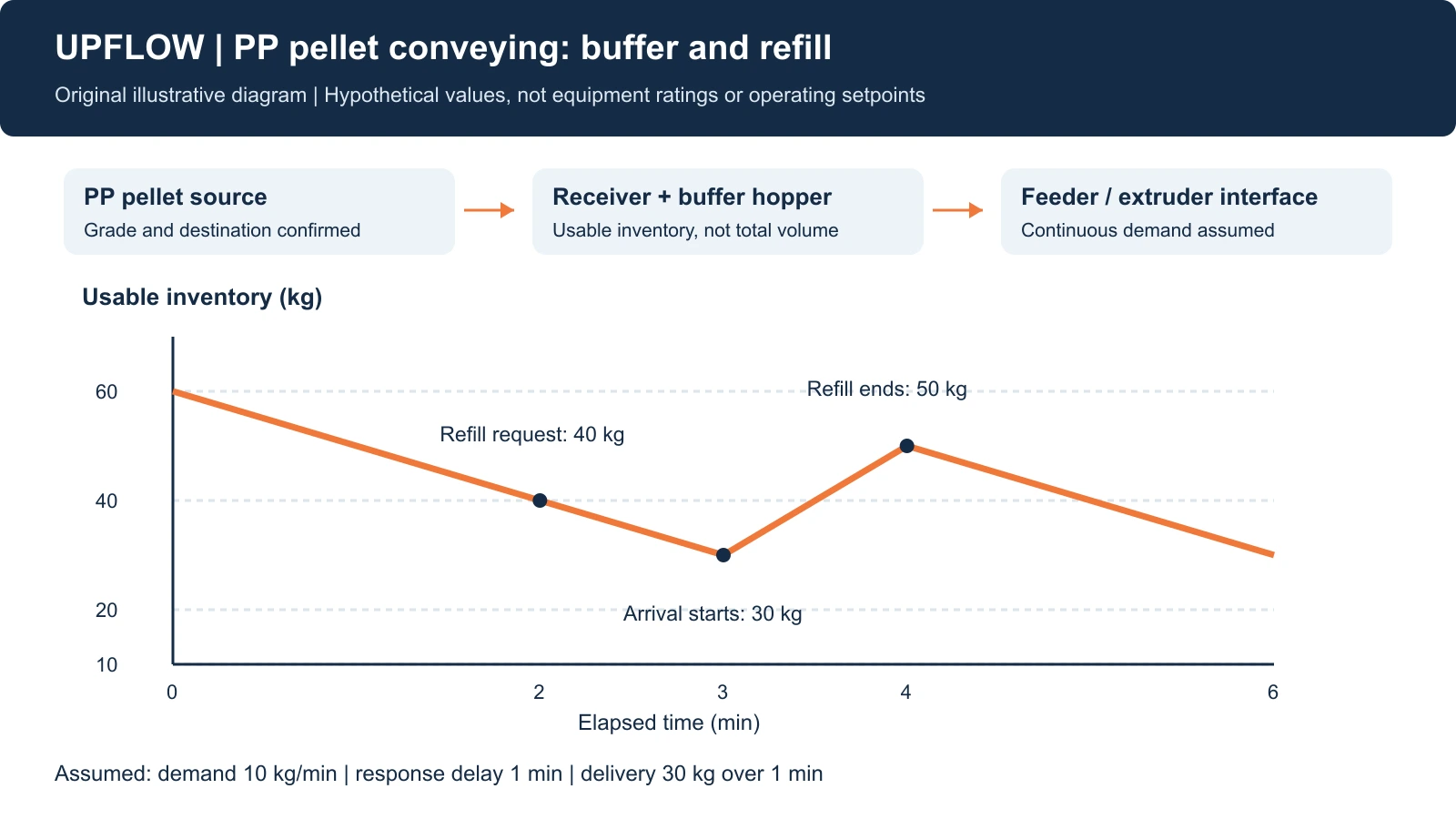
Every number below is assumed for explanation. It is not an UPFLOW rating, measured PP trial or recommended operating setting. Assume constant consumption of 10 kg/min, a request at 40 kg, one minute to first usable arrival, and delivery of 30 kg over the next minute while consumption continues.
| Event | Calculation | Usable inventory |
|---|---|---|
| Initial state at minute 0 | Assumed starting inventory | 60 kg |
| Refill request at minute 2 | 60 − 2 × 10 | 40 kg |
| Arrival starts at minute 3 | 40 − 1 × 10 | 30 kg |
| Arrival ends at minute 4 | 30 + 30 − 1 × 10 | 50 kg |
| Minute 6, before another illustrated event | 50 − 2 × 10 | 30 kg |
The plotted request, arrival and completion are different events. Repeat the balance using the longest verified response delay and realistic demand changes, not merely an average. A production acceptance trial must establish whether the proposed reserve, refill capacity and high-level protection are appropriate.
Coordinate shared receivers and shortage responses
| Observed condition | Evidence to record | Response ownership to agree |
|---|---|---|
| Refill request waits in a queue | Request time, receiver priority and first arrival time | Conveying controller and production owner |
| Source unavailable or wrong grade selected | Source identifier and destination assignment | Material control and conveying controller |
| High level occurs before expected delivery ends | Inventory trend and stop/discharge events | Receiver and hopper-interface suppliers |
| Low inventory persists after a request | Arrival mass and actual process demand | Conveying, feeder and extruder owners |
Agree the shortage escalation with the extruder supplier rather than letting a buffer simply run empty. For a batch receiver, use the complete-cycle conveying capacity method when estimating usable delivery. Grade or colour changes require a separate retained-material and routing review; our plastic pellet changeover checklist covers that boundary.
A relevant receiving-interface project
The PVC powder vacuum conveying project includes multiple receiving points, hopper modifications and high-level detection. Its receiving and control interfaces are relevant to a refill discussion, but its material is PVC powder. It does not establish PP pellet capacity, extruder feeding stability or the inventory values used here.
Watch the vacuum feeding arrangement
This UPFLOW animation shows a general vacuum feeding arrangement. Use it to identify collection and downstream discharge. It is not a PP extrusion trial or a measured buffer-control demonstration.
Watch on UPFLOW’s YouTube channel.
Frequently asked questions
Can a larger hopper alone solve extruder starvation?
Only if the cause and usable capacity support that choice. Source interruptions, queue delays, restricted discharge or inadequate delivered output require their own investigation.
Is conveying rate the same as extrusion feed rate?
No. Intermittent transfer and controlled process feeding are separate duties, even when included in one integrated system.
Can the same settings be copied from PET or PA pellets?
Do not assume so. Record the actual PP grade and form, route, feeder and process demand. Confirm the proposed arrangement with representative material.
Discuss your PP pellet refill requirement
Send the grade, route, demand profile and request-to-arrival records to UPFLOW for a complete pneumatic conveying system review. Include the buffer and feeder boundaries in the enquiry.